Showing posts with label Agenda. Show all posts

Agenda: Jan. 11-15, 2016

Advanced Placement World History with Mr. Duez
Unit 4 Early Modern World, 1540 - 1750
Chapter 14 -- Empires and Encounters, 1450–1750
Chapter 15 -- World Commerce, 1450-1750
Chapter 16 -- Science & Religion, 1450-1750
Week at a Glance:
MON: Reading Check Quiz CH 14; Review Quiz
TUE: Impact of Colombian Exchange on Economic World:
Russian Empire compared with Americas-Fur Trade
WED/THU: Article: A Slaves Journey. Read and annotate.; Silver Mines; Slavery
Video Clip - African Queen Queen Nzinga & Her story of slavery from Mankind: A Story of Us All
FRI: Andrew Marr: Unit 4 video
--
Article: A Slaves Journey Read & annotate due on Wed/Thu
COMP Timed Writing: Wed/Thu Jan 27/28th
Chapter 15 Quiz is on Tuesday, Jan. 19th
Chapter 16 Quiz is on Monday, Jan. 25th
TEST Unit 4 (14, 15, 16): Wed/Thu Jan 27/28th
Unit 4 is quite an explosive time period. Empires, Exploration, Enterprise, and Enrichment.
-----------------------------------------------------------------------------------------------------------
Learning Targets:

★ To explore the creation of the first true global economy in the period 1450–1750
★ To examine Western European commercial expansion in a context that gives due weight to the contributions of other societies
★ To encourage appreciation of China as the world’s largest economy in the early modern period
★ To increase student awareness of the high costs of the commercial boom of the early modern period in ecological and human terms
★ To investigate the various models of trading post empires that were created in this period

Essential Questions:

1. In what specific ways did trade foster change in the world of the early modern era?
2. To what extent did Europeans transform earlier patterns of commerce, and in what ways did they
assimilate into those older patterns?
3. Describe and account for the differing outcomes of European expansion in the Americas (see Chapter 14), Africa, and Asia.
4. How should we distribute the moral responsibility for the Atlantic slave trade? Is this a task appropriate for historians?
5. What lasting legacies of early modern globalization are evident in the early twenty-first century? Pay particular attention to the legacies of the slave trade.

-----------------------------------------------------------------------------------------------------------
Monday, January  11, 2016
Quote: “Being deeply loved by someone gives you strength, while loving someone deeply gives you courage.” ― Lao Tzu

Agenda:
1. Read Check Quiz Chapter 14: Students may use hand written notes
2. Review the quiz in class, discuss questions.

Assignments:
COMP Timed Writing: Wed/Thu Jan 27/28th
Chapter 15 Quiz is on Tuesday, Jan. 19th
Chapter 16 Quiz is on Monday, Jan. 25th
TEST Unit 4 (14, 15, 16): Wed/Thu Jan 27/28th
Queen Anna Nzinga, also known as Ana de Sousa Nzinga Mbande, was a 17th-century queen of the Ndongo and Matamba Kingdoms of the Mbundu people in Angola. 
-----------------------------------------------------------------------------------------------------------
Tuesday, January  12, 2016
Quote: “That which does not kill us makes us stronger.” ― Friedrich Nietzsche

Agenda:
1. DO NOW: How should we distribute the moral responsibility for the Atlantic slave trade? Is this a task appropriate for historians?
3. Notes, Video, Discussion: Russian Empire compared with Americas-Fur Trade

Assignments:

COMP Timed Writing: Wed/Thu Jan 27/28th
Chapter 15 Quiz is on Tuesday, Jan. 19th
Chapter 16 Quiz is on Monday, Jan. 25th
TEST Unit 4 (14, 15, 16): Wed/Thu Jan 27/28th
(insert drama) Hello... I'm Peter Weller.
-----------------------------------------------------------------------------------------------------------
Wednesday, January  13, 2016 & Thursday, January 14, 2016
Quote: “Anyone can hide. Facing up to things, working through them, that's what makes you strong.” ― Sarah Dessen

Agenda:
1. DO NOW QUESTION: Pick up document at the front: Slavery Document. Article: A Slaves Journey Read and annotate.
2. Discuss Document in groups & Full Class - Collect
3. Notes, Discussion, Video: World Commerce - the 3 S's -- Slaves, Silver, & Soft Gold (furs)
Slavery, Silver, Sugar, Fur = a new world economy.
Video Clip - African Queen Queen Nzinga a Mbande & Her story of slavery from Mankind: A Story of Us All

Assignments:
Article: A Slaves Journey. Read & annotate due on Wed/Thu
COMP Timed Writing: Wed/Thu Jan 27/28th
Chapter 15 Quiz is on Tuesday, Jan. 19th
Chapter 16 Quiz is on Monday, Jan. 25th
TEST Unit 4 (14, 15, 16): Wed/Thu Jan 27/28th
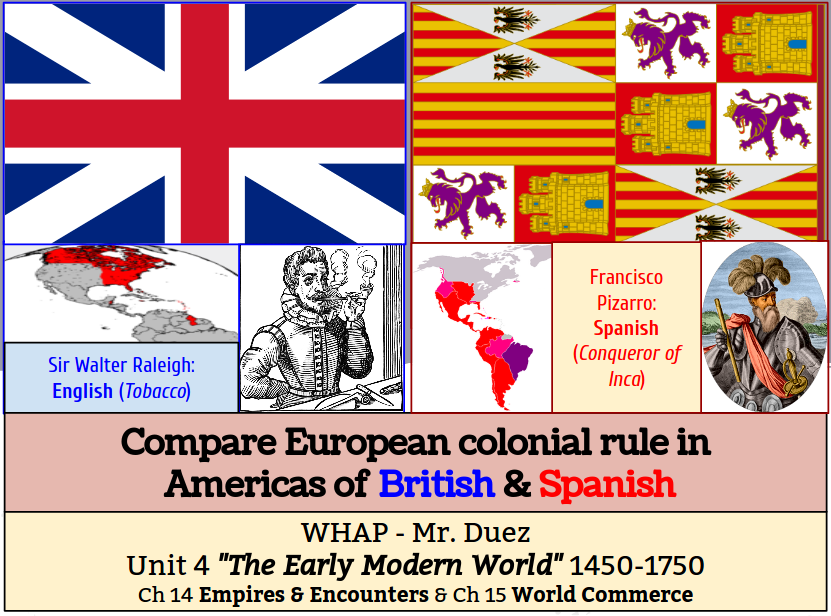
There are some key differences between how the colonial world developed: Slavery, Culture, & Impact on environment.
-----------------------------------------------------------------------------------------------------------
Friday, January  15, 2015
Quote: "Strength of character means the ability to overcome resentment against others, to hide hurt feelings, and to forgive quickly." - Lawrence G. Lovasik

Agenda:

1. Andrew Marr's A History of the World: Plunder
We'll watch segments and then discuss as a class.
  • How does it relate to Strayer's Unit 4?
  • What is the big picture?
  • Change Over Time?
  • World Historical Context?
  • Anything Marr's "Point of View" - that may be biased or influenced in some way?
Assignments:
MLK Day - No School Monday
COMP Timed Writing: Wed/Thu Jan 27/28th
Chapter 15 Quiz is on Tuesday, Jan. 19th
Chapter 16 Quiz is on Monday, Jan. 25th
TEST Unit 4 (14, 15, 16): Wed/Thu Jan 27/28th

Agenda: May 26 - June 4 - Last 2 weeks!

Advanced Placement World History with Mr. Duez
Genocide: Rwanda & Legacy; Local Houston History; Video Project
Review Week & Final Exams
WEEK at a Glance:
Tue May 26 - Fri May 29
MON - No School - Memorial Day
TUE - Collect Movie Questions; Hotel Rwanda: Look back at what we learned; Genocide Prevention; Video Project Discussion
WED/THU - Video Project discussion; Local Houston/Humble/Atascocita History
FRI - Extra Credit Due; Video Project Due; Local Houston/Humble/Atascocita History; Review for Final Exams

Week of Monday - Thursday, June 1-4
 Last week of the school year...
MON & TUE - Review; Watch any Video Projects; Sign Exemptions
WED - Finals
THU - Finals
DONE! 

FINAL EXAM SCHEDULE:
----------------------------------------------------------------------
Tuesday, May 26, 2015
Quote: "And we shall shine on, like the moon and the stars and the sun." - John Lennon

Agenda:
1. DO NOW: Could a genocide ever happen in the United States? Why/Why Not?
--Prepare Hotel Rwanda Questions/Answers we will turn them in this period--
2. Rwandan Genocide Notes, Video, & Discussion.
3. Rwanda Today: Video, Notes,  Discussion.
4. Turn in Hotel Rwanda Questions.
5. Video Project - Questions/Time to work in groups.

Genocide Today:
Where are there trouble spots? 
South Sudan: In July 2011, South Sudan became the world’s newest country after its citizens voted for independence from Sudan. The country faces great challenges as it seeks to build its democratic institutions, overcome a history of internal conflict based on ethnicity, and resolve ongoing tensions with Sudan over the region’s oil resources. Since the 1950s, the Arab-dominated government of Sudan has tried to impose its control on African minorities on the country’s periphery. More than 2.5 million civilians have been killed in a succession of brutal conflicts—between north and south, in Darfur in the west, and in other regions.

Syria: Since its outbreak in April 2011, the conflict in Syria has already cost well over 100,000 lives, displaced millions, and involved numerous atrocities and crimes against humanity. Its increasing sectarian nature puts certain regions and peoples at risk of genocide.

How can I do anything about it?
EndGenocide.org: 
“Never Again!” That’s what leaders in the United States and throughout the world declared after the Holocaust. Yet tragically, in Cambodia, Bosnia, Rwanda and Darfur millions of people lost their lives, lost their families or were forced to flee their homes. History doesn't have to keep repeating itself. The powerful movement in response to the Darfur genocide showed us that by acting together, we can compel our elected leaders to act on their responsibility to protect innocent men, women and children from brutal regimes. We believe that, working together, we can prevent mass atrocities and we can end genocide by:
  • Sounding the alarm and demanding action;
  • Stopping the enablers of genocide and mass atrocities; and
  • Making genocide prevention a core value in U.S. foreign policy.
Genocide Prevention Task Force (Part of the US Holocaust Museum):
The Genocide Prevention Task Force was launched in November 2007, and released its report to the public on December 8, 2008. Co-chaired by Madeleine K. Albright and William S. Cohen, the task force was co-convened by the US Holocaust Memorial Museum, The American Academy of Diplomacy, and the US Institute of Peace, and it was funded by private foundations. Its purpose was to spotlight genocide prevention as a national priority, and develop practical policy recommendations to enhance the capacity of the US government to respond to emerging threats of genocide and mass atrocities.
----------------------------------------------------------------------
Wednesday, May 27, 2015 & Thursday, May 28, 2015
Quote: "Any fool can criticize, condemn, and complain and most fools do." - Benjamin Franklin

Agenda:
1. DO NOW: Why is Humble called Humble anyway?
2. Local History Unit: Discuss Houston, Humble, & Atascocita History.
3. Video Project: Discussion/Group work to prepare. Due Friday.
4. Discuss Final Exam in WHAP.
If Time Permits: AP Psychology Class Preview.
Houston is developing quite a great reputation across the country. 
----------------------------------------------------------------------
Friday, May 29, 2015
Quote: "To achieve great things, two things are needed: a plan, and not quite enough time." - Leonard Bernstein

Agenda:
1. DO NOW: Prepare extra credit ~ both video project
2. Local History Unit: Discuss Houston, Humble, & Atascocita History.
3. Psychology Class Preview.
4. Discuss Final Exam in WHAP.
5. Work on Video Project with Mr. Duez
I will forever miss you my boy. RIP: Gryffindor Duez, the Gryffa-Gryff!
----------------------------------------------------------------------
Monday, June 1, 2013
Quote: “People who see life as anything more than pure entertainment are missing the point.” - George Carlin

Agenda:
1. Work on video project with Mr. Duez
2. Local History Unit: Discuss Galveston, Houston, Humble, & Atascocita History.
3. Psychology Class Preview.
4. Discuss Final Exam in WHAP.
5. Work on Video Project with Mr. Duez

----------------------------------------------------------------------
Tuesday, June 2, 2015 -- Through -- Thursday, June 4th, 2015
Quote: “As they say in my hometown, Don't Forget To Be Awesome." - John Green

Thanks for a GREAT SEMESTER! 

Agenda:
1. Final Exams

Agenda: Week of April 13-17, 2015

Advanced Placement World History with Mr. Duez
PART SIX THE MOST RECENT CENTURY 1914–2010
CHAPTER 23 Independence in the Global South, 1914-2014
WEEK AT A GLANCE:
MON: QUIZ 24; Review Quiz; Crash Course #41
TUE: Discuss the main themes of Ch 24: Comparing the perspectives of accelerating connections in the Global North and Global South according to these factors:
Economic Globalization, Environmentalism, Feminism, Fundamentalism
WED/THU: TEST - 23, 24: Independence Movements; Global Interactions
50 M/CH questions in 45 min.
30 min for the Comparative Essay. Mr. Duez will flip a coin between these two choices:
1. Post WWII, compare the independence movements of India and Africa.
2. During a time period of accelerating connections (1945-Present day), compare the ideological approaches of the Global North and Global South.  (Keep in mind their perspectives according to these factors: Economic Globalization, Environmentalism, Feminism, Fundamentalism)
FRI: DBQ Prep
Only 2 Crash Course World History episodes remain. Globalization I & II.
==========================================
Monday, April 13, 2015
Quote: "In 5-billion years the Sun will expand & engulf our orbit as the charred ember that was once Earth vaporizes. Have a nice day." - @NeilTyson

PART SIX THE MOST RECENT CENTURY 1914–2010
CHAPTER 24 Accelerating Global Interaction, Since 1945
• To consider the steps since 1945 that have increasingly made human populations into a single “world” rather than citizens
• To explore the factors that make it possible to speak now of a true “world economy”
• To explore the debate about economic globalization
• To raise student awareness of global liberation movements, especially feminism, and their implications for human life
• To investigate the “fundamentalist” religious response to aspects of modernity
• To consider environmentalism as a matter that cannot help but be global because the stakes are so high for all humankind 
• To step back and ponder the value of studying history

1. To what extent did the processes discussed in this chapter (economic globalization, feminism, fundamentalism, environmentalism) represent something new in the twentieth century? In what respects did they have roots in the more distant past?
2. In what ways did the global North/South divide find expression in the twentieth and early twenty-first centuries?
3. What have been the benefits and drawbacks of globalization since 1945?
4. Do the years since 1914 confirm or undermine Enlightenment predictions about the future of humankind?
5. “The twentieth century marks the end of the era of Western dominance in world history.” What evidence might support this statement? What evidence might contradict it?
6. To what extent do you think the various liberation movements of the twentieth and early twenty-first centuries—communism, nationalism, democracy, feminism, internationalism—have achieved their goals?
7. Based on material in Chapters 21, 22, and 24, how might you define the evolving roles of the United States in the twentieth and early twenty-first centuries?

MARGIN REVIEW QUESTIONS:
1. What factors contributed to economic globalization during the twentieth century?
2. In what ways has economic globalization linked the world’s peoples more closely together?
3. What new or sharper divisions has economic globalization generated?
4. What distinguished feminism in the industrialized countries from that of the Global South?
5. In what respect did the various religious fundamentalists of the twentieth century express hostility to global
6. From what sources did Islamic renewal movements derive?
7. In what different ways did Islamic renewal express itself?
8. How can we explain the dramatic increase in the human impact on the environment in the twentieth century?
9. What differences emerged between environmentalism in the Global North and that in the Global South?

Agenda:
1. DO NOW: Prep for Reading Check Quiz CH 24 - the LAST ONE!
After quiz begin to formulate your answer for this question: Comparing the perspectives of accelerating connections in the Global North and Global South according to these factors: 
Economic Globalization, Environmentalism, Feminism, Fundamentalism
2. QUIZ: Reading Check CH 24 - The End of Strayer.
3. Review Quiz #24
If time allows: Crash Course World History #41 Globalization
Discuss in relation to the chapter and "The Future History of the Planet"
Thomas Hoepker's controversial photograph of the afternoon of Sept. 9, 2011.
==========================================
Tuesday, April 14, 2015
Quote: "Apollo in 1969. Shuttle in 1981. Nothing in 2011. Our space program would look awesome to anyone living backwards thru time." - Neil deGrasse Tyson @NeilTyson

PART SIX THE MOST RECENT CENTURY 1914–2010
CHAPTER 24 Accelerating Global Interaction, Since 1945
• To consider the steps since 1945 that have increasingly made human populations into a single “world” rather than citizens
• To explore the factors that make it possible to speak now of a true “world economy”
• To explore the debate about economic globalization
• To raise student awareness of global liberation movements, especially feminism, and their implications for human life
• To investigate the “fundamentalist” religious response to aspects of modernity
• To consider environmentalism as a matter that cannot help but be global because the stakes are so high for all humankind 
• To step back and ponder the value of studying history

1. To what extent did the processes discussed in this chapter (economic globalization, feminism, fundamentalism, environmentalism) represent something new in the twentieth century? In what respects did they have roots in the more distant past?
2. In what ways did the global North/South divide find expression in the twentieth and early twenty-first centuries?
3. What have been the benefits and drawbacks of globalization since 1945?
4. Do the years since 1914 confirm or undermine Enlightenment predictions about the future of humankind?
5. “The twentieth century marks the end of the era of Western dominance in world history.” What evidence might support this statement? What evidence might contradict it?
6. To what extent do you think the various liberation movements of the twentieth and early twenty-first centuries—communism, nationalism, democracy, feminism, internationalism—have achieved their goals?
7. Based on material in Chapters 21, 22, and 24, how might you define the evolving roles of the United States in the twentieth and early twenty-first centuries?

MARGIN REVIEW QUESTIONS:
1. What factors contributed to economic globalization during the twentieth century?
2. In what ways has economic globalization linked the world’s peoples more closely together?
3. What new or sharper divisions has economic globalization generated?
4. What distinguished feminism in the industrialized countries from that of the Global South?
5. In what respect did the various religious fundamentalists of the twentieth century express hostility to global
6. From what sources did Islamic renewal movements derive?
7. In what different ways did Islamic renewal express itself?
8. How can we explain the dramatic increase in the human impact on the environment in the twentieth century?
9. What differences emerged between environmentalism in the Global North and that in the Global South?

Agenda:
1. DO NOW: To what extent did the processes discussed in this chapter: 
economic globalization, feminism, fundamentalism, environmentalism
represent something new in the twentieth century? 
In what respects did they have roots in the more distant past?
2. Notes, Video, Discussion:  Chapter 24 Presentation with video examples.2.
Review Questions: In class group discussion to answer review questions over Chapter 24: Review Questions - Globalism, Feminism, Fundamentalism, & Environmentalism.
==========================================
Wednesday, April 15, 2015 & Thursday, April 16, 2015 
I can't believe I read the whole thing!
Quote: "A 'No' uttered from the deepest conviction is better than a 'Yes' merely uttered to please, or worse, to avoid trouble." - Mahatma Gandhi

PART SIX THE MOST RECENT CENTURY 1914–2014
CHAPTER 23 Independence in the Global South, 1914-2014
CHAPTER 24 Accelerating Global Interaction, Since 1945

Agenda:
1. DO NOW: Prep for Final Strayer Test of the Year! Chapters 22, 23, & 24
2. TEST - 23, 24: Independence Movements; Global Interactions
50 M/CH questions in 45 min.
30 min for the Comparative Essay. Mr. Duez will flip a coin between these two choices:
1. Post WWII, compare the independence movements of India and Africa.
2. During a time period of accelerating connections (1945-Present day), compare the ideological approaches of the Global North and Global South.  (Keep in mind their perspectives according to these factors: Economic Globalization, Environmentalism, Feminism, Fundamentalism)
Earthrise.
==========================================
Wednesday, April 17, 2015 
Quote: "History is nothing but a problem of mechanics applied to psychology." - Hippolyte Taine
French critic and historian. He was the chief theoretical influence of French naturalism, a major proponent of sociological positivism and one of the first practitioners of historicist criticism.

1. DO NOW: Pick up DBQ Information from the front.
2. 2005 DBQ: We will work in groups this period to analyze the 2005 DBQ Question, grade student samples, and discuss how this essay can be created.

Agenda: Week of Feb. 9 - Feb. 13, 2015


Advanced Placement World History with Mr. Duez
Unit 5: The European Moment, 1750 - 1914
Chapter 17: The Atlantic Revolutions and Their Echoes
-and-
Chapter 18: The Industrial Revolution
Week at a Glance:
MON: Quiz Ch 18; Review 18 Quiz
TUE: Revolutions of Industry; Document Based Question Skills - POV, Historical Context; Analysis
WED/THU: TEST Unit 5, Part I: CH 17 & 18 -- Atlantic Revolutions & Revolutions of Industry
FRI: CCOT Skills; Timelines; WHC; Prep for Timed Writing next Fri.

Test Wed/Thu Unit 5: Part I, CH 17 & 18
No Quiz next week (no school on Monday)

Next Friday, Feb. 20th: CCOT 2 - Timed Writing in class.
Directions: You are to answer the following question. You should spend 5 minutes organizing or outlining your essay.

Write an essay that:
• Has a relevant thesis and supports that thesis with appropriate historical evidence. 
• Addresses all parts of the question. 
• Uses world historical context to show continuities and changes over time. 
• Analyzes the process of continuity and change over time. 

1. Analyze changes and continuities in long-distance migrations in the period from 1700 to 1900. Be sure to include specific examples from at least TWO different world regions.

2. Analyze the changes and continuities in labor systems between 1750-1914 in ONE of the following areas. In your analysis, be sure to discuss the causes of the changes and the reasons for the continuities.
               Latin America and the Caribbean
               Russia                
               Sub-Saharan Africa
Why did the Industrial Revolution take hold and seem to explode in Great Britain?
-------------------------------------------------
Monday, February 9th, 2015
Quote: "Change is the law of life. And those who look only to the past or present are certain to miss the future." - John F. Kennedy

Learning Targets:
• To explore the causes and consequences of the Industrial Revolution
• To root Europe’s Industrial Revolution in a global context
• To examine the question of why industrialization first “took off ” in Great Britain
• To heighten student awareness of both the positive and the negative effects of the Industrial Revolution
• To examine some of the ways in which nineteenth-century industrial powers exerted an economic imperialism over their non-industrialized neighbors

Essential Questions:
1. What was revolutionary about the Industrial Revolution?
2. What was common to the process of industrialization everywhere, and in what ways did that process vary from place to place?
3. What did humankind gain from the Industrial Revolution, and what did it lose?
4. In what ways might the Industrial Revolution be understood as a global rather than simply a European phenomenon?

Agenda:
1. Quiz Chapter 18 The Industrial Revolution
2. Review CH 17 & 18 Quizzes
3. DBQ Analysis. We will do POV, Analysis, and Meaning of several documents regarding Industry and Revolution.
The Russian Revolution definitely qualifies as "Revolution of Industry".
-------------------------------------------------
Tuesday, February 10th, 2015
Quote: "Change does not roll in on the wheels of inevitability, but comes through continuous struggle. And so we must straighten our backs and work for our freedom. A man can't ride you unless your back is bent." - Martin Luther King, Jr.

Learning Targets:
• To explore the causes and consequences of the Industrial Revolution
• To root Europe’s Industrial Revolution in a global context
• To examine the question of why industrialization first “took off ” in Great Britain
• To heighten student awareness of both the positive and the negative effects of the Industrial Revolution
• To examine some of the ways in which nineteenth-century industrial powers exerted an economic imperialism over their non-industrialized neighbors

Essential Questions:
1. What was revolutionary about the Industrial Revolution?
2. What was common to the process of industrialization everywhere, and in what ways did that process vary from place to place?
3. What did humankind gain from the Industrial Revolution, and what did it lose?
4. In what ways might the Industrial Revolution be understood as a global rather than simply a European phenomenon?

Agenda:
1. DO NOW: Review the document on the screen, write out the meaning & point of view.
2. Notes, Video, Discussion: Revolutions of Industry
3. DBQ Analysis. We will do POV, Analysis, and Meaning of several documents regarding Industry and Revolution. 
Link to DBQ for Industrial Revolution 
Link to DBQ for Atlantic Revolutions
-------------------------------------------------
Wednesday, February 11th and 12th, 2015
Quote: "To improve is to change; to be perfect is to change often." - Winston Churchill

Agenda:
1. TEST - Unit 5 - The European Moment, Part I:
Chapter 17 Atlantic Revolutions & Chapter 18 Revolutions of Industry
The Industrial Revolution made life better, but progress came with a cost. 
-------------------------------------------------
Friday, February 13, 2015
Quote: "I have noticed even people who claim everything is predestined, and that we can do nothing to change it, look before they cross the road." - Stephen Hawking

Agenda:
1. DO NOW: Pick up the CCOT Packet from the front of the room. 
2. CCOT: Timeline, tips, and practice.
Thesis writing
Analysis
Showing change/continuity over time
World Historical Context
Ok, get ready... set... let's go! CCOT #2 of the spring.
--------------------------------------------------------------------------
Next Friday, Feb. 20th: CCOT 2 - Timed Writing in class.
Directions: You are to answer the following question. You should spend 5 minutes organizing or outlining your essay.

Write an essay that:
• Has a relevant thesis and supports that thesis with appropriate historical evidence. 
• Addresses all parts of the question. 
• Uses world historical context to show continuities and changes over time. 
• Analyzes the process of continuity and change over time. 

1. Analyze changes and continuities in long-distance migrations in the period from 1700 to 1900. Be sure to include specific examples from at least TWO different world regions.

2. Analyze the changes and continuities in labor systems between 1750-1914 in ONE of the following areas. In your analysis, be sure to discuss the causes of the changes and the reasons for the continuities.
               Latin America and the Caribbean
               Russia                
               Sub-Saharan Africa

Agenda: Feb 2 - Feb 6, 2015

World History AP with Mr. Duez
Unit 5: THE EUROPEAN MOMENT IN WORLD HISTORY, 1750-1914
Chapter 17 Atlantic Revolutions & their Echoes
Chapter 18 Revolutions of Industry
Week at a Glance:
MON: Quiz Ch 17; French Revolution Compared to other Atlantic Revolutions
TUE: ; French Revolution Documentary w/Questions
WED/THU: French Revolution Documentary w/Questions; The Art of the French Revolution
FRI: CCOT: Discuss good/bad with previous essay; look at good examples of work (Thesis, WHC); Intro to the Industrial Revolution - Chapter 18
As it still does today, art inspired people of the Atlantic Revolutions, David's Oath of the Horatii - cartoon version.
------------------------------------------
Chapter 17 - Atlantic Revolutions - TARGETS
Link to History Channel's Documentary The French Revolution, Part I: Intro to Fall of Bastille

Link to Questions to answer for French Revolution Documentary 

Crash Course World History - Revolutions:
-------------------------------------------
Monday, February 2, 2015
Quote of the Day: "One must maintain a little bit of summer, in the the midst of winter." H. D. Thoreau

Learning Targets:
• Understand the number and diversity of Atlantic revolutions in the eighteenth and nineteenth centuries and how forces at work through the Enlightenment impacted them
• Explore the cross-pollination between revolutionary movements and compare their various causes and overall results
• Compare the real impact of the Atlantic revolutions on their citizens and understand the global impact of the revolutionary movement of the era.
• Consider the consequences of using violence to achieve liberty and equality.
* How much violence is necessary or justifiable?

Essential Questions:
1. In what ways did the ideas of the Enlightenment contribute to the Atlantic revolutions?
2. What was revolutionary about the American Revolution, and what was not?
3. How did the French Revolution differ from the American Revolution?
4. Compare the Atlantic Revolutions.

Agenda:
1. Quiz CH 17 - Reading Check. Students may use hand written notes on the quiz.
2. Review CH 17 Quiz ~ Atlantic Revolutions
3. Notes, Discussion: Atlantic Revolutions Compared

Assignments:
We are watching the French Revolution Documentary and answering the questions in class. 
Read Chapters 17 & 18. Be able to compare the Atlantic Revolutions. 
Begin working on Industrial Revolution, Chapter 18 - so that you are prepared for the quiz on Ch 18. TEST over 17 & 18 is on Wednesday/Thursday Feb. 11th and 12th.
-------------------------------------------
Tuesday, Feb. 3, 2015
Quote of the Day:  "A snow day literally and figuratively falls -unbidden - and seems like a thing of wonder." Susan Orlean

Learning Targets:
• Understand the number and diversity of Atlantic revolutions in the eighteenth and nineteenth centuries and how forces at work through the Enlightenment impacted them
• Explore the cross-pollination between revolutionary movements and compare their various causes and overall results
• Compare the real impact of the Atlantic revolutions on their citizens and understand the global impact of the revolutionary movement of the era.
• Consider the consequences of using violence to achieve liberty and equality.
* How much violence is necessary or justifiable?

Essential Questions:
1. In what ways did the ideas of the Enlightenment contribute to the Atlantic revolutions?
2. What was revolutionary about the American Revolution, and what was not?
3. How did the French Revolution differ from the American Revolution?
4. Compare the Atlantic Revolutions.

Agenda:
1. French Revolution Documentary - answer the questions as we view and we will pause and discuss throughout.
2. Discuss the answers to the question and the video. What are the reasons for revolution in France

Assignments:
We are watching the French Revolution Documentary and answering the questions in class. 
Read Chapters 17 & 18. Be able to compare the Atlantic Revolutions. 
Begin working on Industrial Revolution, Chapter 18 - so that you are prepared for the quiz on Ch 18. TEST over 17 & 18 is on Wednesday/Thursday Feb. 11th and 12th.
The Tennis Court Oath, by David
-------------------------------------------
Wednesday, Feb. 4th, 2015 & Thursday, Feb. 5, 2015
Quote of the Day:  "Nothing burns like the cold." - Anon.

Learning Targets:
• Understand the number and diversity of Atlantic revolutions in the eighteenth and nineteenth centuries and how forces at work through the Enlightenment impacted them
• Explore the cross-pollination between revolutionary movements and compare their various causes and overall results
• Compare the real impact of the Atlantic revolutions on their citizens and understand the global impact of the revolutionary movement of the era.
• Consider the consequences of using violence to achieve liberty and equality.
* How much violence is necessary or justifiable?

Essential Questions:
1. In what ways did the ideas of the Enlightenment contribute to the Atlantic revolutions?
2. What was revolutionary about the American Revolution, and what was not?
3. How did the French Revolution differ from the American Revolution?
4. Compare the Atlantic Revolutions.

Agenda:
1. French Revolution Documentary - answer the questions as we view and we will pause and discuss throughout.
2. Notes, Video, Discussion: The Art of the French Revolution.

Assignments:
We are watching the French Revolution Documentary and answering the questions in class. 
Read Chapters 17 & 18. Be able to compare the Atlantic Revolutions. 
Begin working on Industrial Revolution, Chapter 18 - so that you are prepared for the quiz on Ch 18. TEST over 17 & 18 is on Wednesday/Thursday Feb. 11th and 12th.
The Death of Marat, by David
-------------------------------------------
Friday, Feb. 6, 2015
Quote of the Day: "One kind word can warm 3 winter months." - Japanese Proverb


Learning Targets:
• Understand the number and diversity of Atlantic revolutions in the eighteenth and nineteenth centuries and how forces at work through the Enlightenment impacted them
• Explore the cross-pollination between revolutionary movements and compare their various causes and overall results
• Compare the real impact of the Atlantic revolutions on their citizens and understand the global impact of the revolutionary movement of the era.
• Consider the consequences of using violence to achieve liberty and equality.
* How much violence is necessary or justifiable?

Essential Questions:
1. In what ways did the ideas of the Enlightenment contribute to the Atlantic revolutions?
2. What was revolutionary about the American Revolution, and what was not?
3. How did the French Revolution differ from the American Revolution?
4. Compare the Atlantic Revolutions.

Agenda:
1. Discuss the CCOT Timed Writing from last month. 
2. Discuss Chapter 17 - Atlantic Revolutions Compared.
3. Introduction to Chapter 18 - Revolutions of Industry

Assignments:
We are watching the French Revolution Documentary and answering the questions in class. 
Read Chapters 17 & 18. Be able to compare the Atlantic Revolutions. 
Begin working on Industrial Revolution, Chapter 18 - so that you are prepared for the quiz on Ch 18. TEST over 17 & 18 is on Wednesday/Thursday Feb. 11th and 12th.

Agenda: Week of Jan. 5 - Jan. 9th, 2015

Advanced Placement World History with Mr. Duez
Unit 4: THE EARLY MODERN WORLD 1450–1750
Chapter 14 -- Empires and Encounters, 1450–1750
Chapter 15 -- World Commerce, 1450-1750
Chapter 16 -- Science & Religion, 1450-1750
WEEK AT A GLANCE:
MON - NO SCHOOL
TUE - 40 Inspirational Speeches in 2 min; Intro Unit 4 & CH 14, 15, & 16; 
WED/THU - America Before Columbus; Discuss video; AP World Exam Info, Stats, Motivation; CCOT: How much change? How much continuity? 
FRI - Columbian Exchange
--
CCOT Timed Writing: Fri, Jan. 16th
Chapter 14 Quiz is on Monday, Jan. 12th
Chapter 15 Quiz is on Tuesday, Jan. 15th
Chapter 16 Quiz is on Monday, Jan. 26th
TEST Unit 4 (14, 15, 16): Wed/Thu Jan 28/29th
---------------------------------------
Tuesday, January 6, 2015
Quote of the Day: "Cheers to a new year and another chance for us to get it right." - Oprah Winfrey

Learning Targets:
• Explain the differences in the variety of empires of the early modern period

• Explain how empire building was not just a Western European phenomenon
• Compare and Contrast the range of colonial societies that evolved and the reasons for differences between them
• Analyze the massive social reordering that attended European colonization in the Western Hemisphere

1. What enabled Europeans to carve out huge empires an ocean away from their homelands?
2. What large-scale transformations did European empires generate?
3. What was the economic foundation of colonial rule in Mexico and Peru? How did it shape the kinds of societies that arose there?
4. How did the plantation societies of Brazil and the Caribbean differ from those of southern colonies in British North America?
5. What distinguished the British settler colonies of North America from their counterparts in Latin America? 
6. In what different ways was European colonial rule expressed and experienced in the Americas? 
7. Why did the European empires in the Americas have such an enormously greater impact on the conquered people than did the Chinese, Mughal, and Ottoman empires? 
8. In what ways did the empires of the early modern era continue patterns of earlier empires? In what ways did they depart from those patterns?

Agenda:
1. Do Now - New Seats on Chart. 
Goals for this semester & AP Test.
3. Notes, Discussion, & Video - Introduction to European Expansion, Colonies in the Americas, & Columbian Exchange.
4. Begin video with guiding questions: America Before Columbus, part II. 

Assignment: Read through the notes for Chapter 14 (NOTES link above). 

CCOT Timed Writing: Fri, Jan. 16th
Chapter 14 Quiz is on Monday, Jan. 12th
Chapter 15 Quiz is on Tuesday, Jan. 15th
Chapter 16 Quiz is on Monday, Jan. 26th
TEST Unit 4 (14, 15, 16): Wed/Thu Jan 28/29th
True.
---------------------------------------
Wednesday & Thursday, January 7th & 8th, 2015
Quote of the Day: "New Year's Resolution: To tolerate fools more gladly, provided this does not encourage them to take up more of my time."  - James Agate

Learning Targets:
• Explain the differences in the variety of empires of the early modern period

• Explain how empire building was not just a Western European phenomenon
• Compare and Contrast the range of colonial societies that evolved and the reasons for differences between them
• Analyze the massive social reordering that attended European colonization in the Western Hemisphere

1. What enabled Europeans to carve out huge empires an ocean away from their homelands?
2. What large-scale transformations did European empires generate?
3. What was the economic foundation of colonial rule in Mexico and Peru? How did it shape the kinds of societies that arose there?
4. How did the plantation societies of Brazil and the Caribbean differ from those of southern colonies in British North America?
5. What distinguished the British settler colonies of North America from their counterparts in Latin America? 
6. In what different ways was European colonial rule expressed and experienced in the Americas? 
7. Why did the European empires in the Americas have such an enormously greater impact on the conquered people than did the Chinese, Mughal, and Ottoman empires? 
8. In what ways did the empires of the early modern era continue patterns of earlier empires? In what ways did they depart from those patterns?

Agenda:
2. Finish the video America Before Columbus, Part II. Afterwards, discuss the viewing questions and where Strayer's text is similar to the video and where it departs.

Assignment:
CCOT Timed Writing: Fri, Jan. 16th
Chapter 14 Quiz is on Monday, Jan. 12th
Chapter 15 Quiz is on Tuesday, Jan. 15th
Chapter 16 Quiz is on Monday, Jan. 26th
TEST Unit 4 (14, 15, 16): Wed/Thu Jan 28/29th
Philosoraptor has a valid point!
---------------------------------------
Friday, January 9, 2015
Quote of the Day: "Always forgive your enemies - nothing annoys them so much." - Oscar Wilde

Learning Targets:
• Explain the differences in the variety of empires of the early modern period

• Explain how empire building was not just a Western European phenomenon
• Compare and Contrast the range of colonial societies that evolved and the reasons for differences between them
• Analyze the massive social reordering that attended European colonization in the Western Hemisphere

1. What enabled Europeans to carve out huge empires an ocean away from their homelands?
2. What large-scale transformations did European empires generate?
3. What was the economic foundation of colonial rule in Mexico and Peru? How did it shape the kinds of societies that arose there?
4. How did the plantation societies of Brazil and the Caribbean differ from those of southern colonies in British North America?
5. What distinguished the British settler colonies of North America from their counterparts in Latin America? 
6. In what different ways was European colonial rule expressed and experienced in the Americas? 
7. Why did the European empires in the Americas have such an enormously greater impact on the conquered people than did the Chinese, Mughal, and Ottoman empires? 
8. In what ways did the empires of the early modern era continue patterns of earlier empires? In what ways did they depart from those patterns?

Agenda:
1. DO NOW: 
2. Notes, Discussion, Video: Columbian Exchange.

Assignment:
CCOT Timed Writing: Fri, Jan. 16th
Chapter 14 Quiz is on Monday, Jan. 12th
Chapter 15 Quiz is on Tuesday, Jan. 15th
Chapter 16 Quiz is on Monday, Jan. 26th
TEST Unit 4 (14, 15, 16): Wed/Thu Jan 28/29th