Week of September 6, 2015

Advanced Placement World History with Mr. Duez
Unit 1 - First Things First, to 500 BCE
Ch. 1 First Humans, Ch. 2 First Farmers, Ch. 3 First Civilizations
WEEK AT A GLANCE:
MON: LABOR DAY - NO SCHOOL
TUE: Reading Check Quiz CH 1 & 2; Quiz Review
WED/THU: Documentary: Guns, Germs, & Steel: Episode I "Out of Eden" with questions; at the end of the period, students will get the article: The Worst Mistake in the History of the Human Race
Due Friday.
FRI: Pick up: The Worst Mistake in the History of the Human Race article after brief discussion. Finish Guns, Germs, and Steel; Discuss Early Humans, evolution of farming, and the first civilizations (Ch 3). Emphasis on the San/Chumash comparison, Neolithic Revolution, & Egypt-Mesopotamia Comparison
Chumash of Southern California
______________________________________________
Monday, Sept. 7, 2015
LABOR DAY - NO SCHOOL
______________________________________________
Tuesday, Sept. 8, 2015
Quote: “People often say that motivation doesn't last. Well, neither does bathing – that’s why we recommend it daily.” - Zig Ziglar

Learning Targets:
To familiarize students with the spread of human societies in the Paleolithic era
To explore the conditions of life in gathering and hunting societies
To examine factors that eventually led to change in the gathering and hunting societies

Essential Questions:
1. What is the significance of the Paleolithic era in world history?
2. In what ways did various Paleolithic societies differ from one another, and how did they change over time?
3. What statements in this chapter seem to be reliable and solidly based on facts, and which ones are more speculative and uncertain?
4. How might our attitudes toward the modern world influence our assessment of Paleolithic societies?
5. In what ways, and why, did Chumash culture differ from that of the San?
6. Why did some Paleolithic peoples abandon earlier, more nomadic ways and begin to live a more settled life?

Agenda:
1. DO NOW: Prep for Reading Check Quiz. You may use any hand written notes. NOTHING PRINTED.
2. Reading Check Quiz - Chapter 1 & Chapter 2
3. Review quiz answers in class.

Assignment:
Quiz on Chapter 3 is Monday.
Read Chapters 1, 2, and 3. Use the Target Sheet. Learn the definitions.
Watch the video notes Mr. Duez has posted.
Unit 1 Test is next Wed/Thu
_________________________________________________
Wednesday, Sept. 9, 2015 -and- Thursday, Sept. 10, 2015
Quote: "If you want to achieve excellence, you can get there today. As of this second, quit doing less-than-excellent work." - Thomas J. Watson
GGAS - Much better than having
to read the book!

Learning Targets:
To make students aware that agriculture evolved independently in several regions of the world
To trace the development of agriculture and its local variations
To consider the social implications of the Agricultural Revolution

Essential Questions:
1. The Agricultural Revolution marked a decisive turning point in human history. What evidence might you offer to support this claim, and how might you argue against it?
2. How did early agricultural societies differ from those of the Paleolithic era? How does the example of settled gathering and hunting peoples such as the Chumash complicate this comparison?
3. Was the Agricultural Revolution inevitable? Why did it occur so late in the story of humankind?
4. “The Agricultural Revolution provides evidence for ‘progress’ in human affairs.” How would you evaluate this statement?
5. What accounts for the emergence of agriculture after countless millennia of human life without it?
6. What different kinds of societies emerged out of the Agricultural Revolution?

Agenda:
1. DO NOW: Viewing Guide: Copy the questions on the overhead for Guns, Germs, and Steel.
2. Video Study: Guns, Germs, and Steel, episode 1: "Out of Eden." Students will watch the video and take notes. Students should also answer the questions from the DO NOW in their notes. We will discuss the video throughout.
3. Diamond article: The Worst Mistake in the History of the Human Race - We will discuss the article on Friday after viewing Guns, Germs, and Steel 

Assignment:
Quiz on Chapter 3 is Monday.
Read Chapters 1, 2, and 3. Use the Target Sheet. Learn the definitions.
Watch the video notes Mr. Duez has posted.
Unit 1 Test is next Wed/Thu
"How come white man have so much cargo, yet can't shoot a bow?" - might not be a direct quote :)
______________________________________________
Friday, Sept. 11, 2015
Quote: "Adversity is the state in which man mostly easily becomes acquainted with himself, being especially free of admirers then." - John Wooden

Learning Targets:
Understand the need for art in the human condition and its purpose in facilitating imagination, knowledge, and understanding.

Essential Questions:
1. Why did paleolithic peoples create cave rock art?
2. What is it about the human condition that makes us want to connect with previous and future generations?
3. What is history?

Agenda:
1. DO NOW: Prep The Worst Mistake in the History of the Human Race article and prepare to turn in to Mr. Duez.
2. Finish Video Study: Guns, Germs, and Steel, episode 1: "Out of Eden." Students will watch the video and take notes. Students should also answer the questions from the DO NOW in their notes. We will discuss the video throughout.
3. Discuss documentary & finish read/annotate Diamond.
4. Discuss What Accounts for the initial breakthrough into civilization?
Emphasis on the San/Chumash comparison, Neolithic Revolution, & Egypt-Mesopotamia Comparison

Assignment:
Quiz on Chapter 3 is Monday.
Read Chapters 1, 2, and 3. Use the Target Sheet. Learn the definitions.
Watch the video notes Mr. Duez has posted.
Unit 1 Test is next Wed/Thu

MS Society Volleyball Game vs. The Woodlands -- T-Shirts


My former student and captain of the Volleyball team, Kailtlyn Smith (#4 above) has been gracious enough to organize a student t-shirt signup and is asking me to collect T-Shirt orders in class this week. Details in the picture below.

I will pass out the sign up sheet in class on Thursday and Friday. Unfortunately, they need the order pretty quickly since the game is just a couple of weeks away.

The game is Tuesday, Sept. 15th against The Woodlands. Even if you can't purchase a shirt, it would be great to see everyone there. As I mentioned in class, I really don't (and can't) go to many after school or evening events. But, since they are honoring me and it is for such a great cause, I'm glad to go. My wife and son will be coming along with me. Hope to see you there, if you can make it.


An Open Letter to my students: "Use this website."

A note to my current Atascocita High School students, "Use this website."

Lots of teachers and students write me and thank me for keeping this website up, free, and open. Others have used it as a valuable resource for 4+ years now. So, what a shame it would be, if you were in my class and failed to use the opportunity as so many others have for so long. 

This is just one example from a teacher in Korea that is teaching AP World History:

I am not writing this to brag or pound my chest. As much work as I have put into this site, it needs more attention to be truly great. This year there will be some nice new tweaks that I am planning that will make the site easier to use. So, why am I writing this? It is to be sure that you are taking full advantage of the opportunity. 

Anyone can succeed in this class, if they just put the time and effort into it. I know everyone says that. But, truly I have seen that happen in the past with students and I know you can grow and improve, just like others have before you.
Since school began, there has been a certain ebb and flow as the week progresses this year.
639 page views today - that is at 8:09 am in the morning here in Texas. 
Six Glasses has been a big part of our course and it has helped students get off to a great start in history.
All-time stats, which is over 4 years, Summer Reading, Strayer, & especially "Notes" are quite popular.
Kind of crazy that 665 people in Nepal have visited. Wow.

Agenda: Week of August 31, 2015

Advanced Placement World History with Mr. Duez
Summer Reading Unit - Standage - Six Glasses
-and-
Strayer Unit 1: First Humans, Chapters 1, 2, & 3
Week at a Glance:
MON - Six Glasses Epilogue - Water: Read/Annotate & Discuss. Review of Themes of World History, Periodization, & Historical Thinking Skills. Meet the author - Standage (video)
TUE - ; Matching pairs concept review for the test
WED/THU - TEST: 6 Glasses; First Humans "Finding the First Humans: When and how did the first humans arrive in the Americas?" 
FRI - 1st Americans article due; Socratic Discussion; Crash Course WH #1 Ag Revolution
-------
MON next week - Quiz Chapter 1 & 2.
------------------------------------------------------------
Monday, August 31, 2015
Quote: "I am a great believer in luck. I find that the harder I work, the more I have of it." - Thomas Jefferson
Targets:
Examination of the major themes of WHAP:
The course covers these 6 themes:
Theme 1: Interaction Between Humans and the Environment
Theme 2: Development and Interaction of Cultures
Theme 3: State-Building, Expansion, and Conflict
Theme 4: Creation, Expansion, and Interaction of Economic Systems
Theme 5: Development and Transformation of Social Structures

1. How was beer "essential" to human civilization?
2. How did the use of wine in Roman culture differ from that of ancient Greece?
3. Why do Christians Drink Wine and Muslims Do Not?
4. How did Columbian Exchange change the globe?
5. What is colonization and how to British imperial power change the world?
6. How does 'coca-colonization' explain American dominance in the 20th century?

Agenda:
1. DO NOW - Pick up the 6 Glasses Epilogue from the front desk. Annotate. (10 min)
2. Discuss the epilogue: Do you agree with Standage that the most important drink of the present and future is WATER?
3. SPICE CHART: Students will get a SPICE chart. They should use this for each of the six drinks, but especially to compare 2 of them. This will help them study for the test and also prepare for any kind of essay prompt. And it emphasizes the 5 themes of AP  World History: Social, Political, Interaction, Culture, Economics.
Mark Phillips speaks with Tom Standage, the author of "A History of the World in 6 Glasses," about the influence of beer, wine, spirits, coffee, tea and cola from the stone-age until the present.

Assignment: 
Fill out the student survey. This is your first grade - due by end of day Tuesday.
Watch the screencasts over Six Glasses, take notes. Prepare for the Text on Wed/Thu
Bring your notes, 3 ring binder, and your brain to class. We will use them in class each day. 
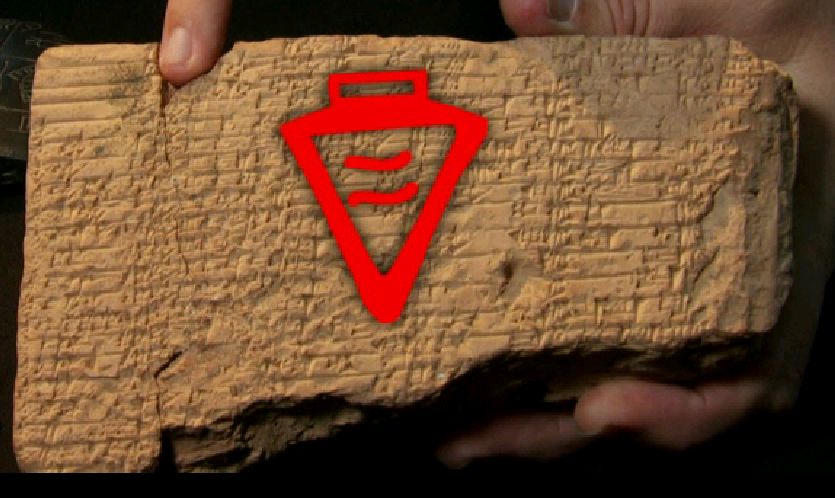
The symbol for "Beer" -- ancient Sumerian writing. (The symbol is a clay pot)
__________________________________________
Tuesday, September 1, 2015
Quote: "I am a great believer in luck. I find that the harder I work, the more I have of it." - Thomas Jefferson
Targets:
Examination of the major themes of WHAP:
The course covers these 6 themes:
Theme 1: Interaction Between Humans and the Environment
Theme 2: Development and Interaction of Cultures
Theme 3: State-Building, Expansion, and Conflict
Theme 4: Creation, Expansion, and Interaction of Economic Systems
Theme 5: Development and Transformation of Social Structures

1. How was beer "essential" to human civilization?
2. How did the use of wine in Roman culture differ from that of ancient Greece?
3. Why do Christians Drink Wine and Muslims Do Not?
4. How did Columbian Exchange change the globe?
5. What is colonization and how to British imperial power change the world?
6. How does 'coca-colonization' explain American dominance in the 20th century?

Agenda:
1. DO NOW - How does Coca-colonization explain American dominance in the 20th Century? 
2. Matching Pairs Quiz - Match words that should be associated with each of the six drinks Standage refers to in his book? (Example, Age of Reasoning = Coffee)
3. Video review: We'll watch video clips that emphasize the importance of each drink/epoch-time period of history.

Assignment: 
Fill out the student survey. This is your first grade - due by end of day Tuesday.
Watch the screencasts over Six Glasses, take notes. Prepare for the Text on Wed/Thu
Bring your notes, 3 ring binder, and your brain to class. We will use them in class each day. 
__________________________________________
Wednesday, Sept 2, 2015 & Thursday, Sept. 3, 2015
Quote: "Unless you pay the price for success, you will not know it's worth." - Apoorve Dubey

Part 1 - First Things First Beginnings in History, to 500 BCE
To familiarize students with the spread of human societies in the Paleolithic era
To explore the conditions of life in gathering and hunting societies
To examine factors that eventually led to change in the gathering and hunting societies 

How do we know our past, before writing?
Essential Questions:
1. What is the significance of the Paleolithic era in world history?
2. In what ways did various Paleolithic societies differ from one another, and how did they change over time?
3. What statements in this chapter seem to be reliable and solidly based on facts, and which ones are more speculative and uncertain?
4. How might our attitudes toward the modern world influence our assessment of Paleolithic societies?

Agenda:
1. TEST - Summer Reading - A History of the World in Six Glasses
2. Read Article: First Humans "Finding the First Humans: When and how did the first humans arrive in the Americas?" 
3. Video: The Incredible Human Journey: Part I by Dr. Alice Roberts
In the first episode of the Incredible Human Journey, Roberts introduces the idea that genetic analysis suggests that all modern humans are descended from Africans. She visits the site of the Omo remains in Ethiopia, which are the earliest known anatomically modern humans. She visits the San people of Namibia to demonstrate the hunter-gatherer lifestyle. In South Africa, she visits Pinnacle Point, to see the cave in which very early humans lived. She then explains that genetics suggests that all non-Africans may descend from a single, small group of Africans who left the continent tens of thousands of years ago. She explores various theories as to the route they took. She describes the Jebel Qafzeh remains in Israel as a likely dead end from a crossing of Suez, and sees a route across the Red Sea and around the Arabian coast as the more probable route for modern human ancestors, especially given the lower sea levels of the past

Assignment: 
Review the notes from Unit 1, either by presentation or Mr. Duez's video. Read Strayer Chapters 1 and 2. Use the Target Sheet for Unit 1. Know your vocabulary for the quiz - along with hand written notes.
Bring your notes, 3 ring binder, and your brain to class. We will use them in class each day. 
Quiz over Chapter 1 and 2 on Monday.
Dr. Alice Roberts: her incredibly inquisitive nature leads her to Africa to discover the beginning of our Human Journey.
__________________________________________
Friday, Sept. 4, 2015
Quote: “Even if you’re on the right track, you’ll get run over if you just sit there." - Will Rogers

Part 1 - First Things First Beginnings in History, to 500 BCE
To familiarize students with the spread of human societies in the Paleolithic era
To explore the conditions of life in gathering and hunting societies
To examine factors that eventually led to change in the gathering and hunting societies 

1. What is the significance of the Paleolithic era in world history?
2. In what ways did various Paleolithic societies differ from one another, and how did they change over time?
3. What statements in this chapter seem to be reliable and solidly based on facts, and which ones are more speculative and uncertain?
4. How might our attitudes toward the modern world influence our assessment of Paleolithic societies?

Agenda:
1. DO NOW - Prep the article First Humans to discuss in class and turn in afterwards.
2. Socratic Text Based Discussion - First Humans "Finding the First Humans: When and how did the first humans arrive in the Americas?" 
3. Crash Course WH Video: If time remains, watch & discuss: Crash Course World History #1 - Agricultural Revolution
Assignment: 
Review the notes from Unit 1, either by presentation or Mr. Duez's video. 
Read Strayer Chapters 1 and 2. 
Use the Target Sheet for Unit 1. 
Know your vocabulary for the quiz - along with hand written notes.
Bring your notes, 3 ring binder, and your brain to class. We will use them in class each day. 
Quiz over Chapter 1 and 2 on Tuesday.
MONDAY IS LABOR DAY.

Agenda - Week of August 24, 2015

Advanced Placement World History with Mr. Duez
Summer Reading Unit - Standage - Six Glasses
Week at a Glance:
MON - Welcome, Introductions, History Pre-Quiz.
TUE - How to use the website, what is a flipped class?, 6 Glasses Discussion
WED/THU - How to WHAP - through 6 Glasses: Periodization, Themes, & Historical Thinking with 6 Glasses
FRI - Quiz over Standage's 6 Glasses. Review the quiz results. How to prepare for the test next Wed/Thu over the summer reading - Standage's 6 Glasses.
Syllabus
WHAP Introduction Information First 2 Weeks To Do List
WHAP Success Form - A checklist of "Things to Do" to achieve success in WHAP.
Tools: Blank SPICE CHART
Mr. Duez's 4th Period WHAP class last year. Many of them will be back with Mr. Duez in AP Psych this year.
--------------------------------------------------------------
Monday, August 24, 2015
Quote: "Begin with the end in mind."

Unit: Introduction to Course: Summer Reading Discussion - A History of the World in 6 Glasses by Tom Standage

Targets:
1. Clearly understand the scope and procedures of WHAP.
2. Examine the major themes of the WHAP course.
3. Understand expectations regarding summer reading text.
4. WHAP Skills: Periodization, Themes, Historical Thinking Skills. Understand them and apply them to the summer reading Six Glasses.

Essential Questions:
1. What is World History?
2. What is Advanced Placement?
3. Why Standage and Six Glasses?

Agenda:
1. DO NOW - Pick up from the front table: Syllabus and 
WHAP Introduction Information First 2 Weeks To Do List
Read, mark, and write down any questions you have as Mr. Duez takes attendance.
2. Welcome to World History ADVANCED PLACEMENT
Discuss the summer reading, syllabus, course objectives.
3. History Pre-Quiz. A quick 20 minute quiz that will check for any knowledge of history students may already have coming into the class. Students will do it on their own. If time permits they will share and compare answers with a partner and then a full class discussion.

Assignment:
Fill out the student survey. Due on Tuesday of next week.
Watch the screencasts over Six Glasses, take note from Mr. Duez's presentations.
Bring your notebook, pens/pencils, and your brain to class. We will use them in class each day.
Bring questions you have over anything and ask them at any time.
Six Glasses: Quiz is on Friday. Test is next Wed/Thu.
Does Standage match each period with a drink, roughly? 
--------------------------------------------------------------
Tuesday, August 25, 2015
Quote: "A journey of a thousand miles begins with a single step." - Laozi

Unit: Introduction to Course And Summer Reading Discussion - A History of the World in 6 Glasses by Tom Standage

Targets:
Examination of the major themes of WHAP:
Theme 1: Interaction Between Humans and the Environment
Theme 2: Development and Interaction of Cultures
Theme 3: State-Building, Expansion, and Conflict (Political)
Theme 4: Creation, Expansion, and Interaction of Economic Systems
Theme 5: Development and Transformation of Social Structures
Mr. Duez created this "SPICE" rack this summer. NICE!
Essential Questions:
1. Which two of the six glasses that Standage refers to are the most similar? How & Why?
2. Which 2 are the most different? How & Why?
3. Can you group them in twos? How & Why?
4. Also discuss periodization through the summer reading:
5. Can you explain the major events from each period that can be tied back to each drink?

Agenda:
1. DO NOW: Which 2 six glasses that Standage refers to are the most similar? Explain How & Why? (Think in terms of WHAP Themes: S.P.I.C.E.)
2. Video Clip: How to Use The Website, by Aidan Duez. (5 min) Discuss any questions after the video ends. Pull up the website, walk through how to find the resources needed to study and prepare for the Six Glasses quiz on Friday & test next Wed/Thu.
3. Six Glasses Comparison: Students will discuss six glasses in terms of grouping the drinks. Which have similar characteristics? Which drinks contributed to world history in similar ways?

Assignment:
Fill out the student survey. Due on Tuesday of next week.
Watch the screencasts over Six Glasses, take note from Mr. Duez's presentations.
Bring your notebook, pens/pencils, and your brain to class. We will use them in class each day.
Bring questions you have over anything and ask them at any time.
Six Glasses: Quiz is on Friday. Test is next Wed/Thu.
The beach and Six Glasses... two great things that work great together! That's why it's summer reading folks!
--------------------------------------------------------------
Wed. & Thu. August 28 & 29, 2015
Quote: “Great minds discuss ideas. Average minds discuss events. Small minds discuss people.” - Eleanor Roosevelt

Unit: Introduction to Course And Summer Reading Discussion - A History of the World in 6 Glasses by Tom Standage

Targets:
Examination of the major themes of WHAP:
Theme 1: Interaction Between Humans and the Environment
Theme 2: Development and Interaction of Cultures
Theme 3: State-Building, Expansion, and Conflict (Political)
Theme 4: Creation, Expansion, and Interaction of Economic Systems
Theme 5: Development and Transformation of Social Structures

Essential Questions:
1. How was beer "essential" to human civilization?
2. How did the use of wine in Roman culture differ from that of ancient Greece?
3. Why do Christians Drink Wine and Muslims Do Not?
4. How did Columbian Exchange change the globe?
5. What is colonization and how to British imperial power change the world?
6. How does 'coca-colonization' explain American dominance in the 20th century?

Agenda:
1. DO NOW: Students will pick up the Introduction to Six Glasses. They will annotate the text by following directions at the top. 
2. Periodization through Six Glasses:
I. Individual students will copy down the periods of world history written on the board. Using their notes from the summer reading, they will pencil in each of the six glasses to where they correspond.
II. Individual students will write the important historical events that occur during those time periods.
III. Working in pairs, students will put their heads together to fill in anything they may be missing. We will also write each drink next to each period on the board. Then write the corresponding important events that may have occurred in those time periods. Students have a better understanding of how Standage's Six Glasses connect with world history.

Discuss these questions in pairs and then as a full class:
A. What was the impact of beer and wine on world history? 
B. Explain what a spirit drink is and what is the significance of this drink on world history?
C. How is coffee a "revolutionary" drink?
D. How is Tea and Coca-Cola similar? 
E. Students will discuss the impact of trade on the globalization of the planet.

3. Video Clip: The History of the World in 7 Minutes. Students will watch the video clip.
A. Then they will discuss their reaction in pairs. 
B. How did the video make you feel, did your feelings change during the video? Why?
C. What is the creator of the video attempting to show? 
D. How does this video portray his "Point of View"?
E. Can you explain the first drink that Standage refers to in context with the video clip?

Assignment:
Fill out the student survey. Due on Tuesday of next week.
Watch the screencasts over Six Glasses, take note from Mr. Duez's presentations.
Bring your notebook, pens/pencils, and your brain to class. We will use them in class each day.
Bring questions you have over anything and ask them at any time.
Six Glasses: Quiz is on Friday. Test is next Wed/Thu.
History is many things to many people. To me, it is pretty awesome.
______________________________
Friday, Aug. 28, 2015 -- shortened periods due to extended Advisory for AHS Pep Rally
Quote: “If opportunity doesn't knock, build a door.” - Milton Berle

Unit: Introduction to Course And Summer Reading Discussion - A History of the World in 6 Glasses by Tom Standage

Targets:
Examination of the major themes of WHAP:
Theme 1: Interaction Between Humans and the Environment
Theme 2: Development and Interaction of Cultures
Theme 3: State-Building, Expansion, and Conflict (Political)
Theme 4: Creation, Expansion, and Interaction of Economic Systems
Theme 5: Development and Transformation of Social Structures

Essential Questions:
1. How was beer "essential" to human civilization?
2. How did the use of wine in Roman culture differ from that of ancient Greece?
3. Why do Christians Drink Wine and Muslims Do Not?
4. How did Columbian Exchange change the globe?
5. What is colonization and how to British imperial power change the world?
6. How does 'coca-colonization' explain American dominance in the 20th century?

Agenda:
1. Quiz over Six Glasses.
2. Review the quiz and answers.
3. How to succeed & survive in WHAP. Advice from students of the past in video form. :)
How will I survive WHAP? - A Google Search - Video YouTube
How to survive AP World History - a student perspective - Video YouTube

Assignment:
Fill out the student survey. Due on Tuesday of next week.
Watch the screencasts over Six Glasses, take note from Mr. Duez's presentations.
Bring your notebook, pens/pencils, and your brain to class. We will use them in class each day.
Bring questions you have over anything and ask them at any time.
Six Glasses: Quiz is on Friday. Test is next Wed/Thu.

Agenda: Week of Aug 22 - 26, 2016

Advanced Placement World History with Mr. Duez
Summer Reading Unit - Standage - Six Glasses
Week at a Glance:
MON - Welcome, Introductions, History Pre-Quiz.
TUE - Success Plan; How to use the website; 6 Glasses Discussion
WED/THU - How to WHAP - through 6 Glasses: Periodization, Themes, & Historical Thinking with 6 Glasses
FRI - Quiz over Standage's 6 Glasses. Review the quiz results. How to prepare for the test next Wed/Thu over the summer reading - Standage's 6 Glasses.

Syllabus
WHAP Introduction Information First 2 Weeks To Do List
WHAP Success Form - A checklist of "Things to Do" to achieve success in WHAP.
Tools: Blank SPICE CHART
Mr. Duez's 4th Period WHAP class last year. Many of them will be back with Mr. Duez in AP Psych this year.
--------------------------------------------------------------
Monday, August 22, 2016
Quote: "Begin with the end in mind."

Unit: Introduction to Course: Summer Reading Discussion - A History of the World in 6 Glasses by Tom Standage

Targets:
1. Clearly understand the scope and procedures of WHAP.
2. Examine the major themes of the WHAP course.
3. Understand expectations regarding summer reading text.
4. WHAP Skills: Periodization, Themes, Historical Thinking Skills. Understand them and apply them to the summer reading Six Glasses.

Essential Questions:
1. What is World History?
2. What is Advanced Placement?
3. Why Standage and Six Glasses?

Agenda:
1. DO NOW - Pick up from the front table: Syllabus and 
WHAP Introduction Information First 2 Weeks To Do List
Read, mark, and write down any questions you have as Mr. Duez takes attendance.
2. Welcome to World History ADVANCED PLACEMENT
Discuss the summer reading, syllabus, course objectives.
3. History Pre-Quiz. A quick 20 minute quiz that will check for any knowledge of history students may already have coming into the class. Students will do it on their own. If time permits they will share and compare answers with a partner and then a full class discussion.

Assignment:
Fill out the student survey. Due on Tuesday of next week.
Watch the screencasts over Six Glasses, take note from Mr. Duez's presentations.
Bring your notebook, pens/pencils, and your brain to class. We will use them in class each day.
Bring questions you have over anything and ask them at any time.
Six Glasses: Quiz is on Friday. Test is next Wed/Thu.
Does Standage match each period with a drink, roughly? 
--------------------------------------------------------------
Tuesday, Aug 23, 2016
Quote: "A journey of a thousand miles begins with a single step." - Laozi

Unit: Introduction to Course And Summer Reading Discussion - A History of the World in 6 Glasses by Tom Standage

Targets:
Examination of the major themes of WHAP:
Theme 1: Interaction Between Humans and the Environment
Theme 2: Development and Interaction of Cultures
Theme 3: State-Building, Expansion, and Conflict (Political)
Theme 4: Creation, Expansion, and Interaction of Economic Systems
Theme 5: Development and Transformation of Social Structures
Mr. Duez created this "SPICE" rack this summer. NICE!
Essential Questions:
1. Which two of the six glasses that Standage refers to are the most similar? How & Why?
2. Which 2 are the most different? How & Why?
3. Can you group them in twos? How & Why?
4. Also discuss periodization through the summer reading:
5. Can you explain the major events from each period that can be tied back to each drink?

Agenda:
1. DO NOW: Which 2 six glasses that Standage refers to are the most similar? Explain How & Why? (Think in terms of WHAP Themes: S.P.I.C.E.)
2. Video Clip: How to Use The Website, by Aidan Duez. (5 min) Discuss any questions after the video ends. Pull up the website, walk through how to find the resources needed to study and prepare for the Six Glasses quiz on Friday & test next Wed/Thu.
3. Six Glasses Comparison: Students will discuss six glasses in terms of grouping the drinks. Which have similar characteristics? Which drinks contributed to world history in similar ways?

Assignment:
Fill out the student survey. Due on Tuesday of next week.
Watch the screencasts over Six Glasses, take note from Mr. Duez's presentations.
Bring your notebook, pens/pencils, and your brain to class. We will use them in class each day.
Bring questions you have over anything and ask them at any time.
Six Glasses: Quiz is on Friday. Test is next Wed/Thu.
The beach and Six Glasses... two great things that work great together! That's why it's summer reading folks!
--------------------------------------------------------------
Wed. & Thu. Aug 24 & 25, 2016
Quote: “Great minds discuss ideas. Average minds discuss events. Small minds discuss people.” - Eleanor Roosevelt

Unit: Introduction to Course And Summer Reading Discussion - A History of the World in 6 Glasses by Tom Standage

Targets:
Examination of the major themes of WHAP:
Theme 1: Interaction Between Humans and the Environment
Theme 2: Development and Interaction of Cultures
Theme 3: State-Building, Expansion, and Conflict (Political)
Theme 4: Creation, Expansion, and Interaction of Economic Systems
Theme 5: Development and Transformation of Social Structures

Essential Questions:
1. How was beer "essential" to human civilization?
2. How did the use of wine in Roman culture differ from that of ancient Greece?
3. Why do Christians Drink Wine and Muslims Do Not?
4. How did Columbian Exchange change the globe?
5. What is colonization and how to British imperial power change the world?
6. How does 'coca-colonization' explain American dominance in the 20th century?

Agenda:
1. DO NOW: Students will pick up the Introduction to Six Glasses. They will annotate the text by following directions at the top. 
2. Periodization through Six Glasses:
I. Individual students will copy down the periods of world history written on the board. Using their notes from the summer reading, they will pencil in each of the six glasses to where they correspond.
II. Individual students will write the important historical events that occur during those time periods.
III. Working in pairs, students will put their heads together to fill in anything they may be missing. We will also write each drink next to each period on the board. Then write the corresponding important events that may have occurred in those time periods. Students have a better understanding of how Standage's Six Glasses connect with world history.

Discuss these questions in pairs and then as a full class:
A. What was the impact of beer and wine on world history? 
B. Explain what a spirit drink is and what is the significance of this drink on world history?
C. How is coffee a "revolutionary" drink?
D. How is Tea and Coca-Cola similar? 
E. Students will discuss the impact of trade on the globalization of the planet.

3. Video Clip: The History of the World in 7 Minutes. Students will watch the video clip.
A. Then they will discuss their reaction in pairs. 
B. How did the video make you feel, did your feelings change during the video? Why?
C. What is the creator of the video attempting to show? 
D. How does this video portray his "Point of View"?
E. Can you explain the first drink that Standage refers to in context with the video clip?

Assignment:
Fill out the student survey. Due on Tuesday of next week.
Watch the screencasts over Six Glasses, take note from Mr. Duez's presentations.
Bring your notebook, pens/pencils, and your brain to class. We will use them in class each day.
Bring questions you have over anything and ask them at any time.
Six Glasses: Quiz is on Friday. Test is next Wed/Thu.
History is many things to many people. To me, it is pretty awesome.
______________________________
Friday, Aug 27, 2016
Quote: “If opportunity doesn't knock, build a door.” - Milton Berle

Unit: Introduction to Course And Summer Reading Discussion - A History of the World in 6 Glasses by Tom Standage

Targets:
Examination of the major themes of WHAP:
Theme 1: Interaction Between Humans and the Environment
Theme 2: Development and Interaction of Cultures
Theme 3: State-Building, Expansion, and Conflict (Political)
Theme 4: Creation, Expansion, and Interaction of Economic Systems
Theme 5: Development and Transformation of Social Structures

Essential Questions:
1. How was beer "essential" to human civilization?
2. How did the use of wine in Roman culture differ from that of ancient Greece?
3. Why do Christians Drink Wine and Muslims Do Not?
4. How did Columbian Exchange change the globe?
5. What is colonization and how to British imperial power change the world?
6. How does 'coca-colonization' explain American dominance in the 20th century?

Agenda:
1. Quiz over Six Glasses.
2. Review the quiz and answers.
3. How to succeed & survive in WHAP. Advice from students of the past in video form. :)
How will I survive WHAP? - A Google Search - Video YouTube
How to survive AP World History - a student perspective - Video YouTube

Assignment:
Fill out the student survey. Due on Tuesday of next week.
Watch the screencasts over Six Glasses, take note from Mr. Duez's presentations.
Bring your notebook, pens/pencils, and your brain to class. We will use them in class each day.
Bring questions you have over anything and ask them at any time.
Six Glasses: Quiz is on Friday. Test is next Wed/Thu.

2015-2016 Bell Schedule

Well, we have a brand new bell schedule this year. Should be interesting. In some ways it is simplier than before, M-T-F schedule is exactly the same bells now, w/o advisory. 5th Period (Which I believe will be my planning/conference period) is now going to be extended to be able to fit the new D Lunch period. So every 5th period is extra long on M-T-F. Wed/Thu is the same as last year, but with an added D lunch each day, which does not add time to lunch period.

It won't be long and we'll know it off by heart! :)

Just a few weeks until it goes into effect.

Enjoy the rest of your summer.

Summer Reading for AP World History

Click this link to see: Six Glasses Information, Reading Check Questions, Notes over the book, and Video Lectures by Mr. Duez over the entire book. 

Welcome to WHAP young Jedi. This is a monumental undertaking that you are about to embark on with, what for many of you is, your first REAL Advanced Placement class. As you have already been forewarned, this is a class that will challenge you to the highest level. Do not let the challenge deter you. You can do it. But it takes hard work.
Believe it or not, that's actually 6 Glasses being read at the beach. I kid you not.
Personally I have just finished the best year of teaching in my career. The students who have blazed a trail before you the previous three years have helped me to create a class where I am certain these things WILL happen:
1. You will learn how to work at a college level.
2. You will write more in this class than any class you have ever had before.
3. You will become skilled in the art and science of analytically thinking through difficult questions and superbly stating your answer when writing a thesis to argue a historical point.
4. You WILL be prepared for the AP World History Test on May 15, 2014. (A mere 341 days, as I write this)
5. You will learn things about the world, history, culture, conflict, and the human condition that you did not know before.
6. You will have fun doing it, but the struggle will not be easy.
The best way to prepare yourself is to get the summer read: "A History of the World in Six Glasses" by Tom Standage and have it read and understood by the first day of school. We will spend the first 10 days discussing the book, learning how Advanced Placement functions, and introducing you to the fast-paced and incredible world of AP World History.

We will have a 6 Glasses quiz on the 1st day of the second week (Mon).
The 6 Glasses test is the first block day (the following Wed/Thu).

These tests and quizzes are not meant to crush you, wean the weak out of this class, or punish those who could not understand the summer reading on their own. The quiz and test are exactly like the ones we will take while studying "The Ways of the World" by Robert W. Strayer during the school year. They are meant to support the outside of class work you will do (and that is a lot!) and prepare you for a very rigorous AP Test in May.

As I mentioned earlier, you will be ready.

The summer reading takes you through the entire course of history that we are preparing to study. It is a wonderful way to prep for the year. Good luck and please feel free to email me if you have any questions: david.duez@gmail.com

Even though it is summer, I don't mind answering emails. I would rather do so now than have confused and intimidated students on the first day of class.

Mr. Duez's Advice to Freshmen About to Enter WHAP

YouTube: Mr. Duez's Advice to Freshmen About to Enter WHAP

Published on May 27, 2015
Mr. Duez talks to freshmen students about the opportunity of taking AP World History, the summer reading, and tips on how to prepare for WHAP. 

Make the best of your summer. Come to WHAP ready to hit the ground running.

Link to all the information for the Summer Reading - A History of the World in Six Glasses by Tom Standage

Google Docs Slides Presentation: WHAP-INTRO-CURRENT-FRESHMEN

Pictures of the Year - Spring 2015

It was a great year! Thank you all so very much.

Safe travels this summer. Stop by and see me next year.

Hope to see some in AP Psychology. :)


Randy Pausch: Really Achieving Your Childhood Dreams

Today during our last class together, I mentioned Randy Pausch and his Last Lecture. Thanks to the awesome technology our of school, I was unable to show you some of the things I wished I could first hand and with me there to discuss it with you. However, I got as much in as I could. And I wanted to share the video out with you so that you could understand more fully what I was referring to.

YouTube: Randy Pausch Last Lecture: Achieving Your Childhood Dreams
Carnegie Mellon Professor Randy Pausch (Oct. 23, 1960 - July 25, 2008) gave his last lecture at the university Sept. 18, 2007, before a packed McConomy Auditorium. In his moving presentation, "Really Achieving Your Childhood Dreams," Pausch talked about his lessons learned and gave advice to students on how to achieve their own career and personal goals.

Life Lessons from The Last Lecture:
1. People are more important than things.
2. Decide if you're a Tigger or Eeyore.
3. Never underestimate the importance of having fun.
4. Work and play well with others.
5. Live with integrity.
6. Tell the truth.
7. Apologize properly.
8. If you wait long enough, anyone will show you their good side.
9. Show gratitude.
10. Don't complain, just work harder.