Agenda: Week of September 17 - 21, 2018

Advanced Placement World History with Mr. Duez
Unit 2 - Strayer Chapters 4, 5, 6
"The Classical Age"
WEEK AT A GLANCE:
MON - Andrew Marr's History of the World Episode 2: Empire; Video Questions & Discussion; Students can take notes as well while we discuss the documentary. 
TUE - Reading Check Quiz CH 4 - students may use handwritten notes; Review Quiz 
WED/THU - Ch 4 - "Eurasian Empires" Comparing Han China & Roman Empire; Writing the LEQ Comparative - LEQ Comparative Practice Prompt: "Compare trade & economics in Han China & Imperial Rome" Thesis & Rubric tips
FRI - Ch 5 - "Eurasian Cultural Traditions" Big Picture Question #1 from Chapter 5: Eurasian Cultural Traditions Crash Course: Buddha & Ashoka


ASSIGNMENTS AT A GLANCE:
Mon Sept 26th Quiz Chapter 5 "Eurasian Empires: Cultural Traditions 500 BCE - 500 CE"
Check the notes, YouTube lectures, and work on the Target Sheets to prepare.

Learning Targets:
★ Define the characteristics of imperial systems in the classical era and analyze why empires developed in some regions but not in others.
★ Compare the important similarities and differences between imperial systems and the reasons behind them
★ Explain the significance that classical empires have for us today, such as, representative government, military power, etc.
★ Evaluate the “greatness” of the Roman Empire and China’s Han Dynasty and determine if their destructive and oppressive features outweighed their impressive advances.

Essential Questions:
1. What common features can you identify in the empires described in this chapter?
2. In what ways did these empires differ from one another? What accounts for those differences?
3. Are you more impressed with the “greatness” of empires or with their destructive and oppressive features? Why?
4. Why did semi democratic governments emerge in some of the Greek city-states?
5. What were the consequences for both sides of the encounter between the Persians and the Greeks
6. What changes did Alexander’s conquests bring in their wake?
7. How did Rome grow from a single city to the center of a huge empire?
8. How and why did the making of the Chinese empire differ from that of the Roman Empire?
9. In comparing the Roman and Chinese empires, which do you find more striking—their similarities or their differences?
10. How did the collapse of empire play out differently in the Roman world and in China?
11. Why were centralized empires so much less prominent in India than in China?
The Classical Age was a time of turmoil, struggle, but yet also much progress.
_________________________________
Monday, Sept. 17, 2018
Quote: Quote: "In three words I can sum up everything I've learned about life: it goes on." - Robert Frost

Agenda:
1. DO NOW: Pick up questions from the front table for the video

2. Video Study: Andrew Marr's History of the World Episode 2: Empire
In this episode, Andrew Marr tells the story of the first empires which laid the foundations for the modern world. From the Assyrians to Alexander the Great, conquerors rampaged across the Middle East and vicious wars were fought all the way from China to the Mediterranean. But this time of chaos and destruction also brought enormous progress and inspired human development. 
In the Middle East, the Phoenicians invented the alphabet, and one of the most powerful ideas in world history emerged: the belief in just one God. In India, the Buddha offered a radical alternative to empire building—a way of living that had no place for violence or hierarchy and was open to everyone. Great thinkers from Socrates to Confucius proposed new ideas about how to rule more wisely and live in a better society. And in Greece, democracy was born—the greatest political experiment of all. 

But within just a few years, its future would be under threat from invasion by an empire in the east: Persia.
Assignment:
Mon Sept 26th Quiz Chapter 5 "Eurasian Empires: Cultural Traditions 500 BCE - 500 CE"
Check the notes, YouTube lectures, and work on the Target Sheets to prepare.
The Greek term karyatides literally means "maidens of Karyai", an ancient town of Peloponnese.
Karyai had a famous temple dedicated to the goddess Artemis of Karyatis
__________________________________
Tuesday, Sept. 18, 2018
Quote: "The shoe that fits one person pinches another; there is no recipe for living that suits all cases." - Carl Jung

Agenda:
1. DO NOW: Prep for Reading Check Quiz over Chapter 4: Eurasian Empires

2. Reading Check Quiz - Chapter 4. (10 minutes) - Students can use their open notes

3. Review Quiz. 

Assignment:
Mon Sept 26th Quiz Chapter 5 "Eurasian Empires: Cultural Traditions 500 BCE - 500 CE"
Check the notes, YouTube lectures, and work on the Target Sheets to prepare.
Andrew Marr travels the globe in Episode 2, History of the World - Empires.
_______________________________________
Wednesday, Sept. 19, 2018
Thursday, Sept. 20, 2018
Quote: "Every man dies. Not every man really lives." - William Wallace

Agenda:
1. DO NOW: Compare trade and economics in Han China & Imperial Rome

2. Notes, Video, Discussion: Comparing Han China & Roman Empire

3. IN CLASS PRACTICE - LEQ Comparative Practice Prompt: "Compare trade & economics in Han China & Imperial Rome"
Example Prompt: 
Analyze the question. Remember you can't write the thesis without the evidence. 
We discussed this in class. Remember our example of Law & Order? You must have the detectives show up on the scene, gather evidence, analyze it, and then they can make a judgement about "Who done it!" Let the evidence you have gathered become your thesis. Don't make this harder than it is.
Example as used by JBartlett in the video referenced/linked below.
Notice that the picture above:
The student references the time period, 
Uses both/however to show similarities/differences.
Student does not get into great detail, but does have 2 similarities and 1 difference. And it is clear.

The thesis now organizes the entire essay: 
2 similarities
3 differences 

Body Paragraphs:
Start with a direct comparison in your Topic Sentence:
Then provide specific evidence - as much as possible to support the comparison.
Then get into analysis - WHY or HOW are they similar or difference (because, the reason for the similarity, due to the fact that, resulted in, etc.)
Notice: "The reason Rome used slaves..." --> analysis.
Body Paragraphs: Write as many body paragraphs as you can, 3-5 should be plenty.

Evidence: usually you need 3 pieces of specific evidence that is related to the prompt and backs your claim.

Direct comparisons: 3+ comparisons made in your paper. This means, do not write one single paragraph that only focuses on one of the two areas you may be trying to compare. Instead compare them both to a point of reference (example: S-P-I-C-E themes).

Analysis: Try to explain the reasons for every comparison you make. You will need 2+ valid analyses for the point. Try this in each body paragraph to be sure you score the points.

Contextualization: Try to connect the topic to the previous period in world history and also to the next period in world history. Or also work on a different theme than the one you are arguing to show 'context' &  do this in each body paragraph to be sure you score.

Remember, each body paragraph should TASC 
Each body paragraph should contain:
TASC:
Topic Sentence (direct comparison)
Analysis as to why the similarity/ difference existed
Support with 3 pieces of evidence 
Connect it to a larger global context, theme, or period

ASSIGNMENTS:
Mon Sept 26th Quiz Chapter 5 "Eurasian Empires: Cultural Traditions 500 BCE - 500 CE"
Check the notes, YouTube lectures, and work on the Target Sheets to prepare.
1787 - David paints "The Death of Socrates"
Socrates, rather than fleeing, uses his death as a final lesson for his pupils, and faces it calmly.
_______________________________
Friday, Sept. 21, 2018
Quote: "All the art of living lies in a fine mingling of letting go and holding on." - Henry Ellis

Agenda:
1. DO NOW: "Religions are fundamentally alike. Does the material in Strayer Chapter 5 back this assertion or argue against it?

2. Notes, Discussion, Video: Discuss Big Picture Question #1 from Chapter 5: Eurasian Cultural Traditions
"Religions are fundamentally alike. Does the material in Strayer Chapter 5 back this assertion or argue against it?

3. Crash Course: Buddha & Ashoka


Assignment:
Mon Sept 26th Quiz Chapter 5 "Eurasian Empires: Cultural Traditions 500 BCE - 500 CE"
Check the notes, YouTube lectures, and work on the Target Sheets to prepare.

Agenda: Week of September 10-14, 2018

Advanced Placement World History with Mr. Duez
Unit 1 - First Humans, Farmers, & Civilizations
& Unit 2 - Eurasian Empires, 500 BCE - 500 CE
WEEK AT A GLANCE:
MON: Reading Check Quiz Chapter 3; Review Quiz
TUE: Unit 1 - The BIG PICTURE; How to Ace the SAQ
WED/THU: TEST UNIT 1 - Chapters 1, 2, and 3; Multiple Choice & SAQ Questions
FRI: Unit 2 - Chapter 4, 5, 6 - "Eurasian Empires" Introduction

ASSIGNMENTS AT A GLANCE:
WED this week: TEST OVER Unit 1 - CH 1, 2, 3  Unit 1; SAQ - Short Answer Questions
Monday, Sept. 25th: Quiz over Chapter 4 Unit 2 Tab & Ch 4

Learning Targets:
★To establish the relationship between the First Civilizations and the Agricultural Revolution
★To contrast civilizations with other forms of human communities
★To explore when, where, and how the First Civilizations arose in human history
★To explore how the emergence of civilizations transformed how humans lived and how their societies were structured
★To show the various ways in which civilizations differed from one another
★To explore the outcomes of the emergence of civilizations, both positive and negative, for humankind

Essential Questions:

1. What distinguished civilizations from other forms of human community?
2. How does the use of the term “civilization” by historians differ from that of popular usage? How do you use the term?
3. “Civilizations were held together largely by force.” Do you agree with this assessment, or were there other mechanisms of integration as well? 
4. In the development of the First Civilizations, what was gained for humankind, and what was lost?
First test is Wednesday, thanks Harvey!
________________________________________
Monday, September 10, 2018
Quote: "The only thing that overcomes hard luck is hard work." - Harry Golden

Agenda:

1. DO NOW: Prep for the reading check quiz over Chapter 3. You can use your handwritten notes.

2. READING CHECK QUIZ - Chapter 3 - First Civilizations

3. Review the quiz

ASSIGNMENTS AT A GLANCE:
WED this week: TEST OVER Unit 1 - CH 1, 2, 3  Unit 1; SAQ - Short Answer Questions

Monday, Sept. 25th: Quiz over Chapter 4 Unit 2 Tab & Ch 4
Be careful. Hard work beats talent when talent doesn't work.
________________________________________
Tuesday, September 11, 2018
Quote: "You never know what worse luck your bad luck has saved you from." - Cormac Mccarthy

Agenda:
1. DO NOW: In what ways did Egypt and Mesopotamia differ from one another? (Also: How were the Indian and Chinese river valley civilizations similar/different?)

2. Notes, Video, & Discussion: River Valley Civilizations - Reviewed

3. Test Prep: Multiple Choice Questions - Best Practices.

ASSIGNMENTS AT A GLANCE:
WED this week: TEST OVER Unit 1 - CH 1, 2, 3  Unit 1; SAQ - Short Answer Questions
Monday, Sept. 25th: Quiz over Chapter 4 Unit 2 Tab & Ch 4
Eurasian Empires is the topic of Chapter 4. "Use the force, young padawans."
________________________________________
Wednesday, September 12, 2018
and
Thursday, September 13, 2018
Quote: "It's hard to detect good luck - it looks so much like something you've earned." - Frank A. Clark

Agenda:
1. DO NOW: Prep for Unit 1 TEST
      
2. TEST UNIT 1: Chapters 1, 2, 3 of Strayer
M/Ch Questions - need a pencil 
SAQ over Six Glasses
Need a black pen and paper

ASSIGNMENTS AT A GLANCE:
WED this week: TEST OVER Unit 1 - CH 1, 2, 3  Unit 1; SAQ - Short Answer Questions
Monday, Sept. 25th: Quiz over Chapter 4 Unit 2 Tab & Ch 4
"Occupy Dock Bay" - The Storm troopers unionize. There goes the empire!
Unit 2 - Eurasian Empires - Chapter 4
Learning Targets:
★ Define the characteristics of imperial systems in the classical era and analyze why empires developed in some regions but not in others.
★ Compare the important similarities and differences between imperial systems and the reasons behind them
★ Explain the significance that classical empires have for us today, such as, representative government, military power, etc.
★ Evaluate the “greatness” of the Roman Empire and China’s Han Dynasty and determine if their destructive and oppressive features outweighed their impressive advances.

Essential Questions:
1. What common features can you identify in the empires described in this chapter?
2. In what ways did these empires differ from one another? What accounts for those differences?
3. Are you more impressed with the “greatness” of empires or with their destructive and oppressive features? Why? 
4. Do you think that the classical empires hold “lessons” for the present, or are contemporary circumstances sufficiently unique as to render the distant past irrelevant?
________________________________________
Friday, September 14, 2018
Quote: "Shallow men believe in luck. Strong men believe in cause and effect." - Ralph Waldo Emerson

**PEP RALLY SCHEDULE** Agenda:
1. DO NOW: Compare the Athenian & Persian Empires according to political, social, and economic factors.

2. Notes, Video, & Discussion: Introduction to Unit 4

3. Extra Credit: How it works. Use the Extra Credit tab above to get all the info you need. 

ASSIGNMENTS AT A GLANCE:
WED this week: TEST OVER Unit 1 - CH 1, 2, 3  Unit 1; SAQ - Short Answer Questions
Monday, Sept. 25th: Quiz over Chapter 4 Unit 2 Tab & Ch 4

Agenda: Week of September 3 - 7, 2018

Advanced Placement World History with Mr. Duez
Unit 1 - CH 1, 2, 3 -- First Humans, Farmers, & Civilizations
WEEK AT A GLANCE:
MON: NO SCHOOL - LABOR DAY
TUE: Reading Check Quiz Chapter 1 & 2; Review Quiz
WED: Video Documentary - Andrew Marr's History of the World, Episode 1: Survival (first 15 min); Human Migration from Africa; First Farmers - Civilization Emerges
THU: Documentary: Guns, Germs, & Steel: Episode I "Out of Eden" with questions
Why did civilization occur where it did on the globe? 

FRI: Notes, Discussion, Video: River Valley Civilizations: How did early civilization develop? What do they share in common? Introduction to the Early River Valley Civilizations: Focus on Egypt & Mesopotamia; Students will create direct comparisons of RV Civs.; Crash Course WH: #1 - Agricultural Revolution

ASSIGNMENTS AT A GLANCE:
Next Monday - Chapter 3 Quiz - you can use hand-written notes
WED next week UNIT 1 Test: CH 1-3 First Peoples, Farmers, & Civilizations

Yeah, it's kinda like that.
Learning Targets:
★To establish the relationship between the First Civilizations and the Agricultural Revolution
★To contrast civilizations with other forms of human communities
★To explore when, where, and how the First Civilizations arose in human history
★To explore how the emergence of civilizations transformed how humans lived and how their societies were structured
★To show the various ways in which civilizations differed from one another
★To explore the outcomes of the emergence of civilizations, both positive and negative, for humankind

Essential Questions:

1. What distinguished civilizations from other forms of human community?
2. How does the use of the term “civilization” by historians differ from that of popular usage? How do you use the term?
3. “Civilizations were held together largely by force.” Do you agree with this assessment, or were there other mechanisms of integration as well? 
4. In the development of the First Civilizations, what was gained for humankind, and what was lost?

Key Concept 1.3 — The appearance of the first urban societies 5,000 years ago laid the foundations for the development of complex civilizations; these civilizations shared several significant social, political, and economic characteristics.
I. Core and foundational civilizations developed in a variety of geographical and environmental settings where agriculture flourished.
II. The first states emerged within core civilizations in Mesopotamia and the Nile River Valley.
III. Culture played a significant role in unifying states through laws, language, literature, religion, myths, and monumental art.
________________________________________
Monday, September 3, 2018

LABOR DAY 2018
NO SCHOOL
________________________________________
Tuesday, September 4, 2018

Quote: "No matter how closely you examine the water, glucose, and electrolyte salts in the human brain, you can't find the point where these molecules became conscious." - Deepak Chopra

Agenda:

1. DO NOW: Prep for the reading check quiz over Chapters 1 & 2. You can use your handwritten notes.

2. READING CHECK QUIZ - Chapters 1 & 2

3. Review the quiz

ASSIGNMENTS AT A GLANCE:
Next Monday - Chapter 3 Quiz - you can use hand-written notes
WED next week UNIT 1 Test: CH 1-3 First Peoples, Farmers, & Civilizations
And they will probably last a little longer...
________________________________________
Wednesday, Sept 5, 2018
Quote: "No matter how closely you examine the water, glucose, and electrolyte salts in the human brain, you can't find the point where these molecules became conscious." - Deepak Chopra

Agenda:
1. DO NOW: Explain the first human migration and how it occurred. 

2. Video Documentary - Andrew Marr's History of the World, Episode 1: Survival (first 15 min); 
We will watch the intro & a few portions to get a feel for what this time period looked like. This video series is much like "Strayer Come to Life" and students in the past have really connected with it. It has made reading the text book much easier because students can visualize and imagine the time period much easier. 

3. Notes, Discussion: Human Migration from Africa; First Farmers - Civilization Emerges

ASSIGNMENTS AT A GLANCE:
Next Monday - Chapter 3 Quiz - you can use hand-written notes
WED next week UNIT 1 Test: CH 1-3 First Peoples, Farmers, & Civilizations


________________________________________
Thursday, Sept 6, 2018 
Quote: "Everything we do, every thought we've ever had, is produced by the human brain. But exactly how it operates remains one of the biggest unsolved mysteries, and it seems the more we probe its secrets, the more surprises we find." - Neil deGrasse Tyson

Agenda:
1. DO NOW: Copy the questions from the screen that we will use to guide our viewing of the documentary. 

2. Documentary: Guns, Germs, & Steel: Episode I "Out of Eden" with questions
Why did civilization occur where it did on the globe? 

3. Discuss documentary. Do you agree with Diamond? 

ASSIGNMENTS AT A GLANCE:
Next Monday - Chapter 3 Quiz - you can use hand-written notes
WED next week UNIT 1 Test: CH 1-3 First Peoples, Farmers, & Civilizations
________________________________________
Friday, September 7, 2018
Quote: "Science is nothing but perception." - Plato

Agenda:
1. DO NOW: What accounts for the initial breakthrough of civilization?

2. Notes, Video, & Discussion: Part I: Comparing River Valley Civilizations: Egypt & Mesopotamia How did early civilization develop? What do they share in common?

3. Crash Course WH: #1 - Agricultural Revolution

ASSIGNMENTS AT A GLANCE:
Next Monday - Chapter 3 Quiz - you can use hand-written notes
WED next week UNIT 1 Test: CH 1-3 First Peoples, Farmers, & Civilizations

Agenda: Week of August 27 - August 31, 2018

Advanced Placement World History with Mr. Duez
Summer Reading Unit - Standage - Six Glasses
-and-
Strayer Unit 1: First Humans, Chapters 1, 2, & 3
Week at a Glance:
MON - Quiz over Summer Reading - A History of the World in Six Glasses; 10 Questions M/Ch; Open notes can be used, provided they are handwritten.
TUE - Introduce of Themes of World History, Periodization, & AP History Disciplinary Practices & Reasoning Skills; Introduction to the LEQ (Long Essay Question) - "The Comparative Essay"
ASSIGNMENTS AT A GLANCE:
This Tuesday: Quiz over 6 Glasses
Wed/Thu this week:  Timed Writing FRQ: Compare 2 of the Six Glasses of World History from the book A History of the World in Six Glasses
This Friday - Article due in class with Socratic Seminar- Diamond's "Mistake
Next week Tuesday: Quiz - Chapter 1 & 2 "First Peoples & First Farmers"
Next week - Unit 1 - 1st Peoples, Farmers, & Civilizations; Including Video Documentary - Part 1 of documentary - "Guns, Germs, and Steel: Out of Eden" by Jared Diamond
------------------------------------------------------------------
STRAYER CHAPTER 1 (PDF of the newest edition, combines CH 1 & 2 of your textbook)
Learning Targets Chapters 1 & 2:

Time Periods of WHAP:

Examination of the major themes of WHAP:
The course covers these 6 themes:
Theme 1: Interaction Between Humans and the Environment
Theme 2: Development and Interaction of Cultures
Theme 3: State-Building, Expansion, and Conflict
Theme 4: Creation, Expansion, and Interaction of Economic Systems
Theme 5: Development and Transformation of Social Structures


Essential Questions:
1. How was beer "essential" to human civilization?
2. How did the use of wine in Roman culture differ from that of ancient Greece?
3. Why do Christians Drink Wine and Muslims Do Not?
4. How did Columbian Exchange change the globe?
5. What is colonization and how to British imperial power change the world?
6. How does 'coca-colonization' explain American dominance in the 20th century?
------------------------------------------------------------
Monday, August 27, 2018
Quote: "I am a great believer in luck. I find that the harder I work, the more I have of it." - Thomas Jefferson

Agenda:
1. Quiz over Summer Reading - "A History of the World in Six Glasses" by Tom Standage
10 M/Ch & T/F questions. 10 minutes. Students can use their hand written notes during the quiz. 

2. Review Quiz: Go over each question to be sure students understand their mistakes. Special attention to the Comparative LEQ and evidence to write the essay next week. 

ASSIGNMENTS AT A GLANCE:
This Tuesday: Quiz over 6 Glasses
Wed/Thu this week:  Timed Writing FRQ: Compare 2 of the Six Glasses of World History from the book A History of the World in Six Glasses
This Friday - Article due in class with Socratic Seminar- Diamond's "Mistake
Next week Tuesday: Quiz - Chapter 1 & 2 "First Peoples & First Farmers"
Next week - Unit 1 - 1st Peoples, Farmers, & Civilizations; Including Video Documentary - Part 1 of documentary - "Guns, Germs, and Steel: Out of Eden" by Jared Diamond
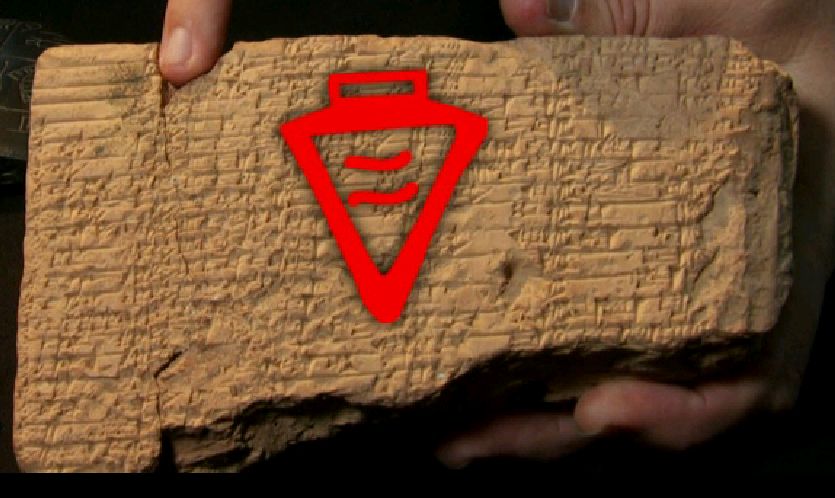
The symbol for "Beer" -- ancient Sumerian writing. (The symbol is a clay pot)
__________________________________________
Tuesday, August 28, 2018
Quote: "Luck is the IDOL of the IDLE." - Proverb

Agenda:
1. DO NOW: Compare 2 of the Six Glasses that Tom Standage wrote about. (Think in terms of SPICE)

2. LEQ Comparative: How to write the Comparative Essay. Write like "Law & Order" - the courtroom lawyer. Opening statement - thesis & claim; Context - explain the circumstances surrounding the question; Provide evidence - prove your claim; Prove beyond a reasonable doubt - Analysis & Reasoning to prove to the reader that you understand the entire complexity of the question. 
Cooperative Activity: Students will work in small groups to write up a comparison of 2 of the drinks. They must have several points of evidence. Present evidence to the group quickly. 

ASSIGNMENTS AT A GLANCE:
This Tuesday: Quiz over 6 Glasses
Wed/Thu this week:  Timed Writing FRQ: Compare 2 of the Six Glasses of World History from the book A History of the World in Six Glasses
This Friday - Article due in class with Socratic Seminar- Diamond's "Mistake
Next week Tuesday: Quiz - Chapter 1 & 2 "First Peoples & First Farmers"
Next week - Unit 1 - 1st Peoples, Farmers, & Civilizations; Including Video Documentary - Part 1 of documentary - "Guns, Germs, and Steel: Out of Eden" by Jared Diamond
__________________________________________
Wednesday, August 29, 2018 & Thursday, August 30, 2018
Quote: "Unless you pay the price for success, you will not know it's worth." - Apoorve Dubey

Agenda:
1. DO NOW: Prepare for the first Timed-Writing FRQ prompt. 

Timed Writing FRQ: Compare 2 of the Six Glasses of World History from the book A History of the World in Six Glasses
2. Pick up Article due in class with Socratic Seminar- Diamond's Mistake
10-15 minutes to read and annotate. Due Friday in class.

2. Notes, Discussion, Video: Strayer Chapter 1 "First Peoples, First Farmers" 

How to use the website to prepare for the Quiz over CH 1 Monday:
  1. Copy Target Sheet
  2. Read through Mr. Duez's notes (or watch YouTube Lectures) and take notes.
  3. Read Strayer & take notes
ASSIGNMENTS AT A GLANCE:
This Friday - Article due in class with Socratic Seminar- Diamond's "Mistake
Next week Tuesday: Quiz - Chapter 1 & 2 "First Peoples & First Farmers"
Next week - Unit 1 - 1st Peoples, Farmers, & Civilizations; Including Video Documentary - Part 1 of documentary - "Guns, Germs, and Steel: Out of Eden" by Jared Diamond
__________________________________________
Friday, August 30, 2018
Quote: “Even if you’re on the right track, you’ll get run over if you just sit there." - Will Rogers

**PEP RALLY SCHEDULE** Shortened Periods at the beginning of the day. 6th & 7th Periods won't be nearly as short for WHAP. 

Agenda:
2. Socratic Text Based Discussion over Diamond's "Mistake" in small groups of 4 students
Use your question, summary, and remember to refer to the text to discuss the article.

3. How to prepare for Quiz over Ch. 1 & 2; Read the pdf version of the newest Strayer which combines Chapter 1 and 2 from our version to help. 

ASSIGNMENTS AT A GLANCE:
Next week Tuesday: Quiz - Chapter 1 & 2 "First Peoples & First Farmers"
Next week - Unit 1 - 1st Peoples, Farmers, & Civilizations; Including Video Documentary - Part 1 of documentary - "Guns, Germs, and Steel: Out of Eden" by Jared Diamond

Agenda: Week of August 20 - August 24, 2018

Advanced Placement World History with Mr. Duez
Summer Reading Unit - Standage - Six Glasses
Week at a Glance:
MON - Welcome, Introductions, Intro to A History of the World in Six Glasses
TUE - Success Plan; Advanced Academics Letter; How to use the website; 6 Glasses Q & A
WED/THU - How to WHAP - through 6 Glasses: Periodization, Themes, & Historical Thinking with 6 Glasses
FRI - Quiz over Standage's 6 Glasses. Review the quiz results.
How to prepare for the test next Thu over the summer reading - Standage's 6 Glasses.
AHS PEP RALLY SCHEDULE PERIOD FRIDAY

WHAP Introduction Information First 2 Weeks To Do List
WHAP Success Form - A checklist of "Things to Do" to achieve success in WHAP.

ASSIGNMENTS:
Monday, August, 27th: Completed the student Survey due
Monday, August, 27th: Signed Advanced Academics Letter due

Next Monday, Aug. 27th: Quiz over Six Glasses
Next Wed/Thu, August 29th & 30th: Timed Writing Comparative over Six Glasses

Watch the screencasts over Six Glasses, take note from Mr. Duez's presentations.
Bring your notebook, pens/pencils, and your brain to class. 
We will use them in class each day.
Bring questions you have over anything and ask them at any time.
Advanced Academics letter due on Monday, August 27th
The survey will help Mr. Duez to better help you!
Unit: Introduction to Course And Summer Reading Discussion - A History of the World in 6 Glasses by Tom Standage

Targets:
Examination of the major themes of WHAP:
Theme 1: Interaction Between Humans and the Environment
Theme 2: Development and Interaction of Cultures
Theme 3: State-Building, Expansion, and Conflict (Political)
Theme 4: Creation, Expansion, and Interaction of Economic Systems
Theme 5: Development and Transformation of Social Structures

Essential Questions:
1. How was beer "essential" to human civilization?
2. How did the use of wine in Roman culture differ from that of ancient Greece?
3. Why do Christians Drink Wine and Muslims Do Not?
4. How did Columbian Exchange change the globe?
5. What is colonization and how to British imperial power change the world?
6. How does 'coca-colonization' explain American dominance in the 20th century?
WHAP this year APUSH next year. Advanced Placement moves you!
--------------------------------------------------------------
Monday, August 20, 2018
Quote: "Begin with the end in mind."

Agenda:
1. DO NOW - Find your name on the screen & your seat in the classroom. 

2. History Pre-Quiz. Using a sheet of paper, write down your answer to each question that is presented on the screen. (These focus on the ideas in the summer reading)

3. Expectations for the year. 

In broad terms:
Why we are here in AP World History? 
To learn about the 10,000 years of human history from a global perspective while putting ourselves in the shoes of those we study. This is not a history class devoted to big events and big names. But rather Change and Continuity, Comparison, and Historical Context. We will learn to do the work of a historian. This includes a lot of writing and you will improve as a writer more this year than any other year of school.

What I expect: 
Very hard work and daily improvement.

Our Goal: 
Pass the AP Exam on Thursday, May 17, 2018.

3. Who Are You?
WHO ARE YOU?
  • What is your name? 
  • Why did you decide to take AP World History?
  • What is your favorite restaurant to eat at?
Present in partner groups. We will most likely finish these throughout the week as we proceed.
ASSIGNMENTS:
Monday, August, 27th: Completed the student Survey due
Monday, August, 27th: Signed Advanced Academics Letter due

Next Monday, Aug. 27th: Quiz over Six Glasses
Next Wed/Thu, August 29th & 30th: Timed Writing Comparative over Six Glasses

Watch the screencasts over Six Glasses, take note from Mr. Duez's presentations.
Bring your notebook, pens/pencils, and your brain to class. 
We will use them in class each day.
Bring questions you have over anything and ask them at any time.
Does Standage match each period with a drink, roughly? 

The 5 Themes of AP World History. 
--------------------------------------------------------------
Tuesday, August 21st, 2018
Quote: "A journey of a thousand miles begins with a single step." - Laozi

Agenda:
1. DO NOW: Pick up from the front table - Success Plan

2. Video Clip: How to Use The Website, by Aidan Duez. (5 min) 
Discuss any questions after the video ends. 
Pull up the website, walk through how to find the resources needed to study.
Concentrate on how to prepare for the Six Glasses quiz on Friday & test next Wed/Thu.

3. Six Glasses Comparison: Students will discuss six glasses in terms of grouping the drinks. 
A. Which have similar characteristics? 
B. Which drinks contributed to world history in similar ways?
C. Using the AP World History Themes (SPICE), group the six glasses & major issues by SPICE grouping. 
D. Justify the theme & why it is essential for that time period in history.

4. Who Are You?
WHO ARE YOU?
  • What is your name? 
  • Why did you decide to take AP World History?
  • What is your favorite restaurant to eat at?
Present in partner groups. We will most likely finish these throughout the week as we proceed.

ASSIGNMENTS:
Monday, August, 27th: Completed the student Survey due
Monday, August, 27th: Signed Advanced Academics Letter due

Next Monday, Aug. 27th: Quiz over Six Glasses
Next Wed/Thu, August 29th & 30th: Timed Writing Comparative over Six Glasses

Watch the screencasts over Six Glasses, take note from Mr. Duez's presentations.
Bring your notebook, pens/pencils, and your brain to class. 
We will use them in class each day.
Bring questions you have over anything and ask them at any time.
The beach and Six Glasses... two great things that work great together! That's why it's summer reading folks!
--------------------------------------------------------------
Wednesday, August 22, 2018
Quote: “Great minds discuss ideas. Average minds discuss events. Small minds discuss people.” - Eleanor Roosevelt

Agenda:
1. DO NOW: Which 2 six glasses that Standage refers to are the most similar? 
Explain How & Why? (Think in terms of WHAP Themes: S.P.I.C.E.)

Video of author Tom Standage discussing each drink on CBS Sunday.

2. FINISH -- Who Are You?
WHO ARE YOU?
  • What is your name? 
  • Why did you decide to take AP World History?
  • What is your favorite restaurant to eat at?

Present in partner groups. We will most likely finish these throughout the week as we proceed.

3. Periodization through Six Glasses:
I. Individual students will copy down the periods of world history written on the board. 

Using their notes from the summer reading, they will pencil in each of the six glasses to where they correspond.

II. Individual students will write the important historical events that occur during those time periods.

III. Working in pairs, students will put their heads together to fill in anything they may be missing. We will also write each drink next to each period on the board. Then write the corresponding important events that may have occurred in those time periods. Students have a better understanding of how Standage's Six Glasses connect with world history.

Discuss these questions in pairs and then as a full class:
A. What was the impact of beer and wine on world history? 
B. Explain what a spirit drink is and what is the significance of this drink on world history?
C. How is coffee a "revolutionary" drink?
D. How is Tea and Coca-Cola similar? 

E. Students will discuss the impact of trade on the globalization of the planet.

ASSIGNMENTS:
Monday, August, 27th: Completed the student Survey due
Monday, August, 27th: Signed Advanced Academics Letter due

Next Monday, Aug. 27th: Quiz over Six Glasses
Next Wed/Thu, August 29th & 30th: Timed Writing Comparative over Six Glasses

Watch the screencasts over Six Glasses, take note from Mr. Duez's presentations.
Bring your notebook, pens/pencils, and your brain to class. 
We will use them in class each day.
Bring questions you have over anything and ask them at any time.
History is many things to many people. To me, it is pretty awesome.
--------------------------------------------------------------
Thursday, August 23, 2018
Quote:  "Life is what happens to you while you're busy making other plans." --John Lennon

1. DO NOW: How did Columbian Exchange change the globe? How does Standage describe it? Which drinks were involved?

2. FINISH -- Who Are You?
WHO ARE YOU?
  • What is your name? 
  • Why did you decide to take AP World History?
  • What is your favorite restaurant to eat at?


Present in partner groups. We will most likely finish these throughout the week as we proceed.

3. Students will be placed in six groups. Each group will have a question that they will write down and discuss. Prepare one answer for their question:
1. How was beer "essential" to human civilization?
2. How did the use of wine in Roman culture differ from that of ancient Greece?
3. Why do Christians drink wine and Muslims do not?
4. How did Columbian Exchange change the globe?
5. What is colonization and how to British imperial power change the world?
6. How does 'coca-colonization' explain American dominance in the 20th century?

ASSIGNMENTS:
Monday, August, 27th: Completed the student Survey due
Monday, August, 27th: Signed Advanced Academics Letter due

Next Monday, Aug. 27th: Quiz over Six Glasses
Next Wed/Thu, August 29th & 30th: Timed Writing Comparative over Six Glasses

Watch the screencasts over Six Glasses, take note from Mr. Duez's presentations.
Bring your notebook, pens/pencils, and your brain to class. 
We will use them in class each day.
Bring questions you have over anything and ask them at any time.
______________________________
Friday, August 24, 2018
Quote: “If opportunity doesn't knock, build a door.” - Milton Berle

Agenda:
1. DO NOW: Students will pick up the LEQ Handouts on the front table. 
LEQ RUBRIC
LEQ Organizer

PRESENTATION: Tips on Writing a Thesis

2. FINISH (if needed) -- Who Are You?
WHO ARE YOU?
  • What is your name? 
  • Why did you decide to take AP World History?
  • What is your favorite restaurant to eat at?

Present in partner groups. We will most likely finish these throughout the week as we proceed.

3. Introduction to the "Long Essay Question" 
LEQ: Comparative (With 6 Glasses)

4. Comparing Two of the Six Glasses:
a) How can they be compared - HISTORICALLY?
b) What historical significance does each drink have?

ASSIGNMENTS:
Monday, August, 27th: Completed the student Survey due
Monday, August, 27th: Signed Advanced Academics Letter due

Next Monday, Aug. 27th: Quiz over Six Glasses
Next Wed/Thu, August 29th & 30th: Timed Writing Comparative over Six Glasses

Watch the screencasts over Six Glasses, take note from Mr. Duez's presentations.
Bring your notebook, pens/pencils, and your brain to class. 
We will use them in class each day.
Bring questions you have over anything and ask them at any time.