Showing posts with label Chapter 16 Science and Religion. Show all posts

Agenda: Jan. 11-15, 2016

Advanced Placement World History with Mr. Duez
Unit 4 Early Modern World, 1540 - 1750
Chapter 14 -- Empires and Encounters, 1450–1750
Chapter 15 -- World Commerce, 1450-1750
Chapter 16 -- Science & Religion, 1450-1750
Week at a Glance:
MON: Reading Check Quiz CH 14; Review Quiz
TUE: Impact of Colombian Exchange on Economic World:
Russian Empire compared with Americas-Fur Trade
WED/THU: Article: A Slaves Journey. Read and annotate.; Silver Mines; Slavery
Video Clip - African Queen Queen Nzinga & Her story of slavery from Mankind: A Story of Us All
FRI: Andrew Marr: Unit 4 video
--
Article: A Slaves Journey Read & annotate due on Wed/Thu
COMP Timed Writing: Wed/Thu Jan 27/28th
Chapter 15 Quiz is on Tuesday, Jan. 19th
Chapter 16 Quiz is on Monday, Jan. 25th
TEST Unit 4 (14, 15, 16): Wed/Thu Jan 27/28th
Unit 4 is quite an explosive time period. Empires, Exploration, Enterprise, and Enrichment.
-----------------------------------------------------------------------------------------------------------
Learning Targets:

★ To explore the creation of the first true global economy in the period 1450–1750
★ To examine Western European commercial expansion in a context that gives due weight to the contributions of other societies
★ To encourage appreciation of China as the world’s largest economy in the early modern period
★ To increase student awareness of the high costs of the commercial boom of the early modern period in ecological and human terms
★ To investigate the various models of trading post empires that were created in this period

Essential Questions:

1. In what specific ways did trade foster change in the world of the early modern era?
2. To what extent did Europeans transform earlier patterns of commerce, and in what ways did they
assimilate into those older patterns?
3. Describe and account for the differing outcomes of European expansion in the Americas (see Chapter 14), Africa, and Asia.
4. How should we distribute the moral responsibility for the Atlantic slave trade? Is this a task appropriate for historians?
5. What lasting legacies of early modern globalization are evident in the early twenty-first century? Pay particular attention to the legacies of the slave trade.

-----------------------------------------------------------------------------------------------------------
Monday, January  11, 2016
Quote: “Being deeply loved by someone gives you strength, while loving someone deeply gives you courage.” ― Lao Tzu

Agenda:
1. Read Check Quiz Chapter 14: Students may use hand written notes
2. Review the quiz in class, discuss questions.

Assignments:
COMP Timed Writing: Wed/Thu Jan 27/28th
Chapter 15 Quiz is on Tuesday, Jan. 19th
Chapter 16 Quiz is on Monday, Jan. 25th
TEST Unit 4 (14, 15, 16): Wed/Thu Jan 27/28th
Queen Anna Nzinga, also known as Ana de Sousa Nzinga Mbande, was a 17th-century queen of the Ndongo and Matamba Kingdoms of the Mbundu people in Angola. 
-----------------------------------------------------------------------------------------------------------
Tuesday, January  12, 2016
Quote“That which does not kill us makes us stronger.” ― Friedrich Nietzsche

Agenda:
1. DO NOW: How should we distribute the moral responsibility for the Atlantic slave trade? Is this a task appropriate for historians?
3. Notes, Video, Discussion: Russian Empire compared with Americas-Fur Trade

Assignments:

COMP Timed Writing: Wed/Thu Jan 27/28th
Chapter 15 Quiz is on Tuesday, Jan. 19th
Chapter 16 Quiz is on Monday, Jan. 25th
TEST Unit 4 (14, 15, 16): Wed/Thu Jan 27/28th
(insert drama) Hello... I'm Peter Weller.
-----------------------------------------------------------------------------------------------------------
Wednesday, January  13, 2016 & Thursday, January 14, 2016
Quote“Anyone can hide. Facing up to things, working through them, that's what makes you strong.” ― Sarah Dessen

Agenda:
1. DO NOW QUESTION: Pick up document at the front: Slavery DocumentArticle: A Slaves Journey Read and annotate.
2. Discuss Document in groups & Full Class - Collect
3. Notes, Discussion, Video: World Commerce - the 3 S's -- Slaves, Silver, & Soft Gold (furs)
Slavery, Silver, Sugar, Fur = a new world economy.
Video Clip - African Queen Queen Nzinga a Mbande & Her story of slavery from Mankind: A Story of Us All

Assignments:
Article: A Slaves Journey. Read & annotate due on Wed/Thu
COMP Timed Writing: Wed/Thu Jan 27/28th
Chapter 15 Quiz is on Tuesday, Jan. 19th
Chapter 16 Quiz is on Monday, Jan. 25th
TEST Unit 4 (14, 15, 16): Wed/Thu Jan 27/28th
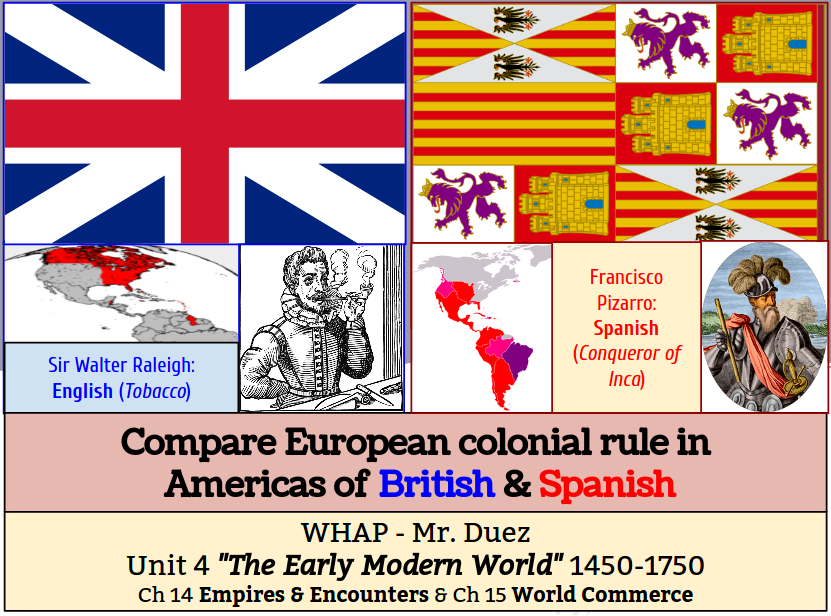
There are some key differences between how the colonial world developed: Slavery, Culture, & Impact on environment.
-----------------------------------------------------------------------------------------------------------
Friday, January  15, 2015
Quote"Strength of character means the ability to overcome resentment against others, to hide hurt feelings, and to forgive quickly." - Lawrence G. Lovasik

Agenda:

1. Andrew Marr's A History of the World: Plunder
We'll watch segments and then discuss as a class.
  • How does it relate to Strayer's Unit 4?
  • What is the big picture?
  • Change Over Time?
  • World Historical Context?
  • Anything Marr's "Point of View" - that may be biased or influenced in some way?
Assignments:
MLK Day - No School Monday
COMP Timed Writing: Wed/Thu Jan 27/28th
Chapter 15 Quiz is on Tuesday, Jan. 19th
Chapter 16 Quiz is on Monday, Jan. 25th
TEST Unit 4 (14, 15, 16): Wed/Thu Jan 27/28th

Agenda: Week of Jan. 26-30, 2015

Advanced Placement World History with Mr. Duez
Unit 4 - Early Modern World, 1450-1750
Chapter 14 - Empires & Encounters
Chapter 15 - World Commerce
Chapter 16 - Science and Religion
Week at a Glance:
MON- Quiz CH 16; Review Quiz
TUE- Counselors for scheduling 2015-16 school year; Silver Trade
WED/THU- TEST Unit 4; Intro to Unit 5 "European Moment" 1750-1914
FRI- The Atlantic Revolutions; American & French; French Revolution Documentary

TEST Unit 4 (CH 14, 15, 16): Wed/Thu
------------------------------------
Monday, January 26, 2015

Quote: 
Learning Targets:
1. Explore the early modern roots of modern tension between religion and science
2. Examine the Reformation movements in Europe and their significance
3. Investigate the global spread of Christianity and the extent to which it syncretized with native traditions
4. Expand the discussion of religious change to include religious movements in China, India, and the Islamic world
5. Explore the reasons behind the Scientific Revolution in Europe, and why that movement was limited in other parts of the world
6. Explore the implications of the Scientific Revolution for world societies

Essential Questions:
1. In what ways did the Protestant Reformation transform European society, culture, and politics? 
2. How was European imperial expansion related to the spread of Christianity?
3. In what ways was European Christianity assimilated into the Native American cultures of Spanish America?
4. Why were missionary efforts to spread Christianity so much less successful in China than in Spanish America?
5. What accounts for the continued spread of Islam in the early modern era and for the emergence of reform or renewal movements within the Islamic world?
6. In what ways did Asian cultural changes in the early modern era parallel those of Europe, and in what ways were they different?
7. Why did the Scientific Revolution occur in Europe rather than in China or the Islamic world?
8. What was revolutionary about the Scientific Revolution?
9. In what ways did the Enlightenment challenge older patterns of European thinking?
10. How did nineteenth-century developments in the sciences challenge the faith of the Enlightenment?
11. In what ways was European science received in the major civilizations of Asia in the early modern era?

Agenda:
1. DO NOW: Prep for Quiz Ch. 16 (students may use hand-written notes)
2. QUIZ Ch 16
DO NOW Question for after quiz: In what ways did the Protestant Reformation transform European society, culture, and politics? 
3. Review Quiz & focus on the question above

Assignments:
TEST Wed/Thu Unit 4
Review Notes for Ch. 14, 15, 16
Use the Online Companion for Strayer
Quizlet is always a great help.
Quizlet: Strayer Unit 4 Vocab
Quizlet: Strayer Unit 4 Questions
Remember the 2006 DBQ Silver Trade - a few questions will focus on point of view and other areas of the DBQ. (Annotated Rubric for help)
------------------------------------
Tuesday, January 27, 2015

Quote:
Learning Targets:
1. Explore the early modern roots of modern tension between religion and science
2. Examine the Reformation movements in Europe and their significance
3. Investigate the global spread of Christianity and the extent to which it syncretized with native traditions
4. Expand the discussion of religious change to include religious movements in China, India, and the Islamic world
5. Explore the reasons behind the Scientific Revolution in Europe, and why that movement was limited in other parts of the world
6. Explore the implications of the Scientific Revolution for world societies

Essential Questions:
1. In what ways did the Protestant Reformation transform European society, culture, and politics? 
2. How was European imperial expansion related to the spread of Christianity?
3. In what ways was European Christianity assimilated into the Native American cultures of Spanish America?
4. Why were missionary efforts to spread Christianity so much less successful in China than in Spanish America?
5. What accounts for the continued spread of Islam in the early modern era and for the emergence of reform or renewal movements within the Islamic world?
6. In what ways did Asian cultural changes in the early modern era parallel those of Europe, and in what ways were they different?
7. Why did the Scientific Revolution occur in Europe rather than in China or the Islamic world?
8. What was revolutionary about the Scientific Revolution?
9. In what ways did the Enlightenment challenge older patterns of European thinking?
10. How did nineteenth-century developments in the sciences challenge the faith of the Enlightenment?
11. In what ways was European science received in the major civilizations of Asia in the early modern era?

Agenda:
1. DO NOW QUESTIONIn what ways did the Protestant Reformation transform European society, culture, and politics? 
2. Notes, Video, Discussion: Protestant Reformation, Scientific Revolution, & The Enlightenment.

Assignments:
TEST Wed/Thu Unit 4
Review Notes for Ch. 14, 15, 16
Use the Online Companion for Strayer
Quizlet is always a great help.
Quizlet: Strayer Unit 4 Vocab
Quizlet: Strayer Unit 4 Questions
Remember the 2006 DBQ Silver Trade - a few questions will focus on point of view and other areas of the DBQ. (Annotated Rubric for help)
With transportation of new world & Asian riches, piracy emerges in the Early Modern Era.
------------------------------------
Wednesday, January 28, 2015 & Thursday, January 29, 2015

Quote: 
Agenda:
1. TEST Unit 4 - Chapters 14, 15, 16
2. After test - Introduce Unit 5 - European Moment, 1750-1914
What was revolutionary about the American Revolution, and what was not?

Assignments:
Read Chapter 17 - prep for quiz on Monday
Atlantic Revolutions & Their Echoes - American, French, Haitian, & Latin American Revolutions
"Mr. Duez, is that real blood, or like, Ketchup or something?"
------------------------------------
Friday, January 30, 2015

Quote: 
Learning Targets:
• Understand the number and diversity of Atlantic revolutions in the eighteenth and nineteenth centuries and how forces at work through the Enlightenment impacted them
• Explore the cross-pollination between revolutionary movements and compare their various causes and overall results
• Compare the real impact of the Atlantic revolutions on their citizens and understand the global impact of the revolutionary movement of the era. 
• Consider the consequences of using violence to achieve liberty and equality.
**How much violence is necessary or justifiable?

Essential Questions:
1. Make a chart comparing the North American, French, Haitian, and Spanish American revolutions. What categories of comparison would be most appropriate to include?
2. Do revolutions originate in oppression and injustice, in the weakening of political authorities, in new ideas, or in the activities of small groups of determined activists?
3. “The influence of revolutions endured long after they ended.” To what extent does this chapter support or undermine this idea?
4. In what ways did the Atlantic revolutions and their echoes give a new and distinctive shape to the emerging societies of nineteenth-century Europe and the Americas?
Also,
1. In what ways did the ideas of the Enlightenment contribute to the Atlantic revolutions?
2. What was revolutionary about the American Revolution, and what was not?
3. How did the French Revolution differ from the American Revolution?
4. What was distinctive about the Haitian Revolution, both in world history generally and in the history of Atlantic revolutions? 
5. How were the Spanish American revolutions shaped by the American, French, and Haitian revolutions that happened earlier?
6. What accounts for the end of Atlantic slavery during the nineteenth century?
7. How did the end of slavery affect the lives of the former slaves?
8. What accounts for the growth of nationalism as a powerful political and personal identity in the nineteenth century?
9. What were the achievements and limitations of nineteenth-century feminism?

Agenda:
1. DO NOW QuestionWhat was revolutionary about the American Revolution, and what was not?
2. Notes, Video, Discussion: American & French Revolutions
3. Video Documentary: History Channel's French Revolution
We'll watch the first 10-15 minutes.
Quiz on Chapter 17 Monday
Tue-Wed/Thu next week we'll focus on finishing this documentary & discussing Atlantic Revolutions in comparison.

Assignments:
Read Chapter 17 - prep for quiz on Monday
Atlantic Revolutions & Their Echoes - American, French, Haitian, & Latin American Revolutions

Agenda: Week of Jan. 19-23, 2015

Advanced Placement World History with Mr. Duez
Unit 4 - Early Modern World, 1450-1750
Chapter 14 - Empires & Encounters
Chapter 15 - World Commerce
Chapter 16 - Science and Religion
Week at a Glance:
MON- MLK Day
TUE- Counselors for scheduling 2015-16 school year; Silver Trade
WED/THU- Quiz CH 15; Silver TradeDBQ Practice-2006 Silver Trade; CCOT Review from last week; Intro: Chapter 16 Science & Religion with The Reformation
FRI- Andrew Marr's A History of the World: Plunder & Revolution

TEST Unit 4 (CH 14, 15, 16): Next Week on Wed/Thu
Martin Luther King, Jr. Memorial Washington, DC
------------------------------------
Monday January 19, 2015 No School MLK Day

QUOTE OF THE WEEK: 
As we'll learn, MLK learned a few things from Mr. Gandhi of India. And he also taught us a few new tricks. RIP.
------------------------------------
Tuesday, January 20, 2015
Quote: "I am more afraid of my own heart than of the pope and all his cardinals. I have within me the great pope, Self." - Martin Luther
Indulge me!

Learning Targets CH. 16 - Science & Religion:
- Examine the early modern roots of modern tension between religion and science
- Compare the Reformation movements in Europe and their significance
- Analyze the global spread of Christianity and the extent to which it syncretized with native traditions
- Expand the discussion of religious change to include religious movements in China, India, and the Islamic world
- Understand the reasons behind the Scientific Revolution in Europe, and why that movement was limited in other parts of the world
- Examine the implications of the Scientific Revolution for world societies 

Essential Questions:

1. Why did Christianity take hold in some places more than in others?
2. In what ways was the missionary message of Christianity shaped by the cultures of Asian and American peoples?
3. Compare the processes by which Christianity and Islam became world religions.
4. In what ways did the spread of Christianity, Islam, and modern science give rise to culturally based conflicts?
5. Based on Chapters 13 through 16, how does the history of Islam in the early modern era challenge a Eurocentric understanding of those centuries?

Agenda:
1. Counselors coming in this period to discuss schedules 2015-2016 school year.
2. Discuss Silver Trade, if time permits.
Luther, word! Indulgences, yo!
------------------------------------
Wednesday & Thursday January 21 & 22, 2015
Quote: "I do not feel obliged to believe that the same God who has endowed us with sense, reason, and intellect has intended us to forgo their use." - Galileo Galilei
Learning Targets CH. 16 - Science & Religion:
- Examine the early modern roots of modern tension between religion and science
- Compare the Reformation movements in Europe and their significance
- Analyze the global spread of Christianity and the extent to which it syncretized with native traditions
- Expand the discussion of religious change to include religious movements in China, India, and the Islamic world
- Understand the reasons behind the Scientific Revolution in Europe, and why that movement was limited in other parts of the world
- Examine the implications of the Scientific Revolution for world societies 

Essential Questions:

1. Why did Christianity take hold in some places more than in others?
2. In what ways was the missionary message of Christianity shaped by the cultures of Asian and American peoples?
3. Compare the processes by which Christianity and Islam became world religions.
4. In what ways did the spread of Christianity, Islam, and modern science give rise to culturally based conflicts?
5. Based on Chapters 13 through 16, how does the history of Islam in the early modern era challenge a Eurocentric understanding of those centuries?

Agenda:
1. Do Now Question: How does the Scientific Revolution & Enlightenment compare to the Protestant Reformation? What characteristics did they share in common?
2. Notes, Video, Discussion: The Reformation
- Protestant Reformation
- Reformation in England
- Scientific Revolution
- The Enlightenment
3. 2006 Silver Trade DBQ: Analysis of documents. Meaning/Importance, POV, Grouping.

Assignment:
Next Class (Wed/Thu) - Quiz Chapter 15 - World Commerce
Next Monday - Quiz Chapter 16 - Science & Religion
Next Wed/Thu - Test Unit 6: The Early Modern World
Neil deGrasse Tyson is an American astrophysicist, cosmologist, author, and science communicator.
------------------------------------
Friday, January 24, 2015
Quote: “An individual has not started living until he can rise above the narrow confines of his individualistic concerns to the broader concerns of all humanity.” - Martin Luther King, Jr.

Learning Targets CH. 16 - Science & Religion:
- Examine the early modern roots of modern tension between religion and science
- Compare the Reformation movements in Europe and their significance
- Analyze the global spread of Christianity and the extent to which it syncretized with native traditions
- Expand the discussion of religious change to include religious movements in China, India, and the Islamic world
- Understand the reasons behind the Scientific Revolution in Europe, and why that movement was limited in other parts of the world
- Examine the implications of the Scientific Revolution for world societies 

Essential Questions:

1. Why did Christianity take hold in some places more than in others?
2. In what ways was the missionary message of Christianity shaped by the cultures of Asian and American peoples?
3. Compare the processes by which Christianity and Islam became world religions.
4. In what ways did the spread of Christianity, Islam, and modern science give rise to culturally based conflicts?
5. Based on Chapters 13 through 16, how does the history of Islam in the early modern era challenge a Eurocentric understanding of those centuries?

Agenda:
1. Andrew Marr's A History of the World: Plunder & Revolution
We will watch segments from two episodes.
We'll watch a segment and then discuss as a class.
  • How does it relate to Strayer's Unit 4?
  • What is the big picture?
  • Change Over Time?
  • World Historical Context?
  • Anything Marr's "Point of View" - that may be biased or influenced in some way?
Assignment:
Monday - Quiz Chapter 16 - Science & Religion
Next Wed/Thu - Test Unit 6: The Early Modern World

Agenda: Week of Jan. 5 - Jan. 9th, 2015

Advanced Placement World History with Mr. Duez
Unit 4: THE EARLY MODERN WORLD 1450–1750
Chapter 14 -- Empires and Encounters, 1450–1750
Chapter 15 -- World Commerce, 1450-1750
Chapter 16 -- Science & Religion, 1450-1750
WEEK AT A GLANCE:
MON - NO SCHOOL
TUE - 40 Inspirational Speeches in 2 min; Intro Unit 4 & CH 14, 15, & 16; 
WED/THU - America Before Columbus; Discuss video; AP World Exam Info, Stats, Motivation; CCOT: How much change? How much continuity? 
FRI - Columbian Exchange
--
CCOT Timed Writing: Fri, Jan. 16th
Chapter 14 Quiz is on Monday, Jan. 12th
Chapter 15 Quiz is on Tuesday, Jan. 15th
Chapter 16 Quiz is on Monday, Jan. 26th
TEST Unit 4 (14, 15, 16): Wed/Thu Jan 28/29th
---------------------------------------
Tuesday, January 6, 2015
Quote of the Day: "Cheers to a new year and another chance for us to get it right." - Oprah Winfrey

Learning Targets:
• Explain the differences in the variety of empires of the early modern period

• Explain how empire building was not just a Western European phenomenon
• Compare and Contrast the range of colonial societies that evolved and the reasons for differences between them
• Analyze the massive social reordering that attended European colonization in the Western Hemisphere

1. What enabled Europeans to carve out huge empires an ocean away from their homelands?
2. What large-scale transformations did European empires generate?
3. What was the economic foundation of colonial rule in Mexico and Peru? How did it shape the kinds of societies that arose there?
4. How did the plantation societies of Brazil and the Caribbean differ from those of southern colonies in British North America?
5. What distinguished the British settler colonies of North America from their counterparts in Latin America? 
6. In what different ways was European colonial rule expressed and experienced in the Americas? 
7. Why did the European empires in the Americas have such an enormously greater impact on the conquered people than did the Chinese, Mughal, and Ottoman empires? 
8. In what ways did the empires of the early modern era continue patterns of earlier empires? In what ways did they depart from those patterns?

Agenda:
1. Do Now - New Seats on Chart. 
Goals for this semester & AP Test.
3. Notes, Discussion, & Video - Introduction to European Expansion, Colonies in the Americas, & Columbian Exchange.
4. Begin video with guiding questions: America Before Columbus, part II

Assignment: Read through the notes for Chapter 14 (NOTES link above). 

CCOT Timed Writing: Fri, Jan. 16th
Chapter 14 Quiz is on Monday, Jan. 12th
Chapter 15 Quiz is on Tuesday, Jan. 15th
Chapter 16 Quiz is on Monday, Jan. 26th
TEST Unit 4 (14, 15, 16): Wed/Thu Jan 28/29th
True.
---------------------------------------
Wednesday & Thursday, January 7th & 8th, 2015
Quote of the Day: "New Year's Resolution: To tolerate fools more gladly, provided this does not encourage them to take up more of my time."  - James Agate

Learning Targets:
• Explain the differences in the variety of empires of the early modern period

• Explain how empire building was not just a Western European phenomenon
• Compare and Contrast the range of colonial societies that evolved and the reasons for differences between them
• Analyze the massive social reordering that attended European colonization in the Western Hemisphere

1. What enabled Europeans to carve out huge empires an ocean away from their homelands?
2. What large-scale transformations did European empires generate?
3. What was the economic foundation of colonial rule in Mexico and Peru? How did it shape the kinds of societies that arose there?
4. How did the plantation societies of Brazil and the Caribbean differ from those of southern colonies in British North America?
5. What distinguished the British settler colonies of North America from their counterparts in Latin America? 
6. In what different ways was European colonial rule expressed and experienced in the Americas? 
7. Why did the European empires in the Americas have such an enormously greater impact on the conquered people than did the Chinese, Mughal, and Ottoman empires? 
8. In what ways did the empires of the early modern era continue patterns of earlier empires? In what ways did they depart from those patterns?

Agenda:
2. Finish the video America Before Columbus, Part II. Afterwards, discuss the viewing questions and where Strayer's text is similar to the video and where it departs.

Assignment:
CCOT Timed Writing: Fri, Jan. 16th
Chapter 14 Quiz is on Monday, Jan. 12th
Chapter 15 Quiz is on Tuesday, Jan. 15th
Chapter 16 Quiz is on Monday, Jan. 26th
TEST Unit 4 (14, 15, 16): Wed/Thu Jan 28/29th
Philosoraptor has a valid point!
---------------------------------------
Friday, January 9, 2015
Quote of the Day: "Always forgive your enemies - nothing annoys them so much." - Oscar Wilde

Learning Targets:
• Explain the differences in the variety of empires of the early modern period

• Explain how empire building was not just a Western European phenomenon
• Compare and Contrast the range of colonial societies that evolved and the reasons for differences between them
• Analyze the massive social reordering that attended European colonization in the Western Hemisphere

1. What enabled Europeans to carve out huge empires an ocean away from their homelands?
2. What large-scale transformations did European empires generate?
3. What was the economic foundation of colonial rule in Mexico and Peru? How did it shape the kinds of societies that arose there?
4. How did the plantation societies of Brazil and the Caribbean differ from those of southern colonies in British North America?
5. What distinguished the British settler colonies of North America from their counterparts in Latin America? 
6. In what different ways was European colonial rule expressed and experienced in the Americas? 
7. Why did the European empires in the Americas have such an enormously greater impact on the conquered people than did the Chinese, Mughal, and Ottoman empires? 
8. In what ways did the empires of the early modern era continue patterns of earlier empires? In what ways did they depart from those patterns?

Agenda:
1. DO NOW: 
2. Notes, Discussion, Video: Columbian Exchange.

Assignment:
CCOT Timed Writing: Fri, Jan. 16th
Chapter 14 Quiz is on Monday, Jan. 12th
Chapter 15 Quiz is on Tuesday, Jan. 15th
Chapter 16 Quiz is on Monday, Jan. 26th
TEST Unit 4 (14, 15, 16): Wed/Thu Jan 28/29th

Notes - Unit 4 - Science & Religion - The Enlightenment

YouTube: Chapter 16 - Science & Religion: The Enlightenment
Notes: Chapter 16 - Science & Religion: The Enlightenment

Notes - Unit 4 - Chapter 16 - Science & Religion: Scientific Revolution

YouTube: Chapter 16 - Scientific Revolution
Notes: Chapter 16 - Scientific Revolution

Targets - Chapter 16 - Religion & Science

Targets - Chapter 16 - Religion & Science
Astronomer Copernicus, or Conversations with God is an oil painting by the Polish artist Jan Matejko, finished in 1873, depicting Nicolaus Copernicus observing the heavens from a balcony by a tower near the cathedral in Frombork.  The scene likely portrays the epiphany moment of Copernicus profound discovery, with his own Heliocentric model drawn on a large flat board standing next to him.

Agenda: Week of Jan. 20 - 24, 2014

Advanced Placement World History with Mr. Duez
Unit 4 - Early Modern World, 1450-1750
Chapter 16 - Science and Religion
Week at a Glance:
MON- MLK Day
TUE- Quiz Ch 16; The Reformation
WED/THU- Reformation, Scientific Revolution, & Enlightenment; Discuss Comparative Essay Tips
FRI- Timed Writing - Chapter 16 Science & Religion. Comparison Essay

Essay Prompts for Friday's Timed Writing:
1) Compare demographic and environmental effects of the Columbian Exchange on the
Americas with the Columbian Exchange’s demographic and environmental effects on
ONE of the following regions between 1492 and 1750.
 Africa
 Asia
 Europe
2) In what ways did Asian cultural changes in the early modern era parallel those of Europe, and in what ways were they different?
3) Why did the Scientific Revolution occur in Europe rather than in China or the Islamic world?
Martin Luther King, Jr. Memorial Washington, DC
------------------------------------
Monday January 21, 2013 - No School MLK Day

QUOTE OF THE WEEK: "Darkness cannot drive out darkness; only light can do that. Hate cannot drive out hate; only love can do that. Hate multiplies hate, violence multiplies violence, and toughness multiplies toughness in a descending spiral of destruction ... The chain reaction of evil -- hate begetting hate, wars producing more wars -- must be broken, or we shall be plunged into the dark abyss of annihilation." - Martin Luther King, Jr. from Strength To Love, 1963.
------------------------------------
Tuesday, January 22, 2013
Quote of the Day: "I am more afraid of my own heart than of the pope and all his cardinals. I have within me the great pope, Self." - Martin Luther

Learning Targets CH. 16 - Science & Religion:
- Examine the early modern roots of modern tension between religion and science
- Compare the Reformation movements in Europe and their significance
- Analyze the global spread of Christianity and the extent to which it syncretized with native traditions
- Expand the discussion of religious change to include religious movements in China, India, and the Islamic world
- Understand the reasons behind the Scientific Revolution in Europe, and why that movement was limited in other parts of the world
- Examine the implications of the Scientific Revolution for world societies 

Essential Questions:
1. Why did Christianity take hold in some places more than in others?
2. In what ways was the missionary message of Christianity shaped by the cultures of Asian and American peoples?
3. Compare the processes by which Christianity and Islam became world religions.
4. In what ways did the spread of Christianity, Islam, and modern science give rise to culturally based conflicts?
5. Based on Chapters 13 through 16, how does the history of Islam in the early modern era challenge a Eurocentric understanding of those centuries?

Agenda:
1. Quiz Chapter 16.
Do Now Question after quiz: In what ways did the Protestant Reformation transform European society, culture, and politics?
2. Review Quiz answers, discuss topics in the chapter and how Science & Religious change compared in this era.
3. Introduce the Reformation. Notes: Protestant Reformation
Andrew Marr's History of the World: Revolution (Introduction)
------------------------------------
Wednesday & Thursday January 23 & 24, 2013
Quote: "I do not feel obliged to believe that the same God who has endowed us with sense, reason, and intellect has intended us to forgo their use." - Galileo Galilei

Learning Targets CH. 16 - Science & Religion:
- Examine the early modern roots of modern tension between religion and science
- Compare the Reformation movements in Europe and their significance
- Analyze the global spread of Christianity and the extent to which it syncretized with native traditions
- Expand the discussion of religious change to include religious movements in China, India, and the Islamic world
- Understand the reasons behind the Scientific Revolution in Europe, and why that movement was limited in other parts of the world
- Examine the implications of the Scientific Revolution for world societies 

Essential Questions:
1. Why did Christianity take hold in some places more than in others?
2. In what ways was the missionary message of Christianity shaped by the cultures of Asian and American peoples?
3. Compare the processes by which Christianity and Islam became world religions.
4. In what ways did the spread of Christianity, Islam, and modern science give rise to culturally based conflicts?
5. Based on Chapters 13 through 16, how does the history of Islam in the early modern era challenge a Eurocentric understanding of those centuries?

Agenda:
1. Do Now Question: How does the Scientific Revolution & Enlightenment compare to the Protestant Reformation? What characteristics did they share in common?
2. Notes, Video, Discussion:
- Protestant Reformation
- Reformation in England
- Scientific Revolution
- The Enlightenment
Finish Andrew Marr's History of the World: Revolution (Introduction)
3. How to write the Comparative Essay: Review from last semester.

Assignment:
Study Chapter 14-15-16 and prep for the comparative essay prompts. One of the 3 will be chosen at the beginning of the period for the timed writing:
1) Compare demographic and environmental effects of the Columbian Exchange on the
Americas with the Columbian Exchange’s demographic and environmental effects on
ONE of the following regions between 1492 and 1750.
 Africa
 Asia
 Europe
2) In what ways did Asian cultural changes in the early modern era parallel those of Europe, and in what ways were they different?
3) Why did the Scientific Revolution occur in Europe rather than in China or the Islamic world?
Neil deGrasse Tyson is an American astrophysicist, cosmologist, author, and science communicator.
------------------------------------
Friday, January 25th, 2013
Quote: “An individual has not started living until he can rise above the narrow confines of his individualistic concerns to the broader concerns of all humanity.” - Martin Luther King, Jr.

Agenda:
Timed Writing - Comparison Essay: Chapter 16 "Religion & Science."
One of these 3 questions will be chosen randomly for each period:
1) Compare demographic and environmental effects of the Columbian Exchange on the
Americas with the Columbian Exchange’s demographic and environmental effects on
ONE of the following regions between 1492 and 1750.
 Africa
 Asia
 Europe
2) In what ways did Asian cultural changes in the early modern era parallel those of Europe, and in what ways were they different?
3) Why did the Scientific Revolution occur in Europe rather than in China or the Islamic world?
Assignment:
Monday - Chapter 17 - Atlantic Revolutions Quiz.

Agenda: Week of Mon-Fri January 21-25, 2013

Advanced Placement World History
Unit 4 - Early Modern World, 1450-1750
Chapter 16 - Science and Religion
Week at a Glance:
MON- MLK
TUE- Quiz Ch 16; The Reformation
WED/THU- Reformation, Scientific Revolution, & Enlightenment
FRI- Timed Writing - Chapter 16 Science & Religion. Comparison Essay
------------------------------------
Monday January 21, 2013 - No School MLK Day
QUOTE OF THE WEEK: "Darkness cannot drive out darkness; only light can do that. Hate cannot drive out hate; only love can do that. Hate multiplies hate, violence multiplies violence, and toughness multiplies toughness in a descending spiral of destruction ... The chain reaction of evil -- hate begetting hate, wars producing more wars -- must be broken, or we shall be plunged into the dark abyss of annihilation." Martin Luther King, Jr. from Strength To Love, 1963.


Learning Targets CH. 16 - Science & Religion:
- To explore the early modern roots of modern tension between religion and science
- To examine the Reformation movements in Europe and their significance
- To investigate the global spread of Christianity and the extent to which it syncretized with native traditions
- To expand the discussion of religious change to include religious movements in China, India, and the Islamic world
- To explore the reasons behind the Scientific Revolution in Europe, and why that movement was limited in other parts of the world
- To explore the implications of the Scientific Revolution for world societies 
Essential Questions:
1. Why did Christianity take hold in some places more than in others?
2. In what ways was the missionary message of Christianity shaped by the cultures of Asian and American peoples?
3. Compare the processes by which Christianity and Islam became world religions.
4. In what ways did the spread of Christianity, Islam, and modern science give rise to culturally based conflicts?
5. Based on Chapters 13 through 16, how does the history of Islam in the early modern era challenge a Eurocentric understanding of those centuries?
Click the picture above for a very good site with video discussing the impact of Martin Luther on pbs.
------------------------------------
Tuesday, January 22, 2013
Quote of the Day: "I am more afraid of my own heart than of the pope and all his cardinals. I have within me the great pope, Self." - Martin Luther
Agenda:
1. Quiz Chapter 16.
Do Now Question after quizIn what ways did the Protestant Reformation transform European society, culture, and politics?
2. Go over Quiz answers, discuss topics in the chapter and how Science & Religious change compared in this era. 
3. Introduce the ReformationNotes: Protestant Reformation
------------------------------------
Wednesday & Thursday January 23 & 24, 2013
Quote of the Day: "I do not feel obliged to believe that the same God who has endowed us with sense, reason, and intellect has intended us to forgo their use." - Galileo Galilei

Agenda:
1. Do Now QuestionHow does the Scientific Revolution & Enlightenment compare to the Protestant Reformation? What characteristics did they share in common?
2. Notes, Video, Discussion:
Protestant Reformation
Reformation in England
Scientific Revolution
The Enlightenment
------------------------------------
Friday, January 25th, 2013
Quote of the Day: “An individual has not started living until he can rise above the narrow confines of his individualistic concerns to the broader concerns of all humanity.” - Martin Luther King, Jr.

Agenda:
1. Timed Writing - Comparison Essay: Chapter 16 "Religion & Science."

Monday - Chapter 17 - Atlantic Revolutions Quiz.