Showing posts with label CCOT Essay. Show all posts

Agenda: Jan. 11-15, 2016

Advanced Placement World History with Mr. Duez
Unit 4 Early Modern World, 1540 - 1750
Chapter 14 -- Empires and Encounters, 1450–1750
Chapter 15 -- World Commerce, 1450-1750
Chapter 16 -- Science & Religion, 1450-1750
Week at a Glance:
MON: Reading Check Quiz CH 14; Review Quiz
TUE: Impact of Colombian Exchange on Economic World:
Russian Empire compared with Americas-Fur Trade
WED/THU: Article: A Slaves Journey. Read and annotate.; Silver Mines; Slavery
Video Clip - African Queen Queen Nzinga & Her story of slavery from Mankind: A Story of Us All
FRI: Andrew Marr: Unit 4 video
--
Article: A Slaves Journey Read & annotate due on Wed/Thu
COMP Timed Writing: Wed/Thu Jan 27/28th
Chapter 15 Quiz is on Tuesday, Jan. 19th
Chapter 16 Quiz is on Monday, Jan. 25th
TEST Unit 4 (14, 15, 16): Wed/Thu Jan 27/28th
Unit 4 is quite an explosive time period. Empires, Exploration, Enterprise, and Enrichment.
-----------------------------------------------------------------------------------------------------------
Learning Targets:

★ To explore the creation of the first true global economy in the period 1450–1750
★ To examine Western European commercial expansion in a context that gives due weight to the contributions of other societies
★ To encourage appreciation of China as the world’s largest economy in the early modern period
★ To increase student awareness of the high costs of the commercial boom of the early modern period in ecological and human terms
★ To investigate the various models of trading post empires that were created in this period

Essential Questions:

1. In what specific ways did trade foster change in the world of the early modern era?
2. To what extent did Europeans transform earlier patterns of commerce, and in what ways did they
assimilate into those older patterns?
3. Describe and account for the differing outcomes of European expansion in the Americas (see Chapter 14), Africa, and Asia.
4. How should we distribute the moral responsibility for the Atlantic slave trade? Is this a task appropriate for historians?
5. What lasting legacies of early modern globalization are evident in the early twenty-first century? Pay particular attention to the legacies of the slave trade.

-----------------------------------------------------------------------------------------------------------
Monday, January  11, 2016
Quote: “Being deeply loved by someone gives you strength, while loving someone deeply gives you courage.” ― Lao Tzu

Agenda:
1. Read Check Quiz Chapter 14: Students may use hand written notes
2. Review the quiz in class, discuss questions.

Assignments:
COMP Timed Writing: Wed/Thu Jan 27/28th
Chapter 15 Quiz is on Tuesday, Jan. 19th
Chapter 16 Quiz is on Monday, Jan. 25th
TEST Unit 4 (14, 15, 16): Wed/Thu Jan 27/28th
Queen Anna Nzinga, also known as Ana de Sousa Nzinga Mbande, was a 17th-century queen of the Ndongo and Matamba Kingdoms of the Mbundu people in Angola. 
-----------------------------------------------------------------------------------------------------------
Tuesday, January  12, 2016
Quote“That which does not kill us makes us stronger.” ― Friedrich Nietzsche

Agenda:
1. DO NOW: How should we distribute the moral responsibility for the Atlantic slave trade? Is this a task appropriate for historians?
3. Notes, Video, Discussion: Russian Empire compared with Americas-Fur Trade

Assignments:

COMP Timed Writing: Wed/Thu Jan 27/28th
Chapter 15 Quiz is on Tuesday, Jan. 19th
Chapter 16 Quiz is on Monday, Jan. 25th
TEST Unit 4 (14, 15, 16): Wed/Thu Jan 27/28th
(insert drama) Hello... I'm Peter Weller.
-----------------------------------------------------------------------------------------------------------
Wednesday, January  13, 2016 & Thursday, January 14, 2016
Quote“Anyone can hide. Facing up to things, working through them, that's what makes you strong.” ― Sarah Dessen

Agenda:
1. DO NOW QUESTION: Pick up document at the front: Slavery DocumentArticle: A Slaves Journey Read and annotate.
2. Discuss Document in groups & Full Class - Collect
3. Notes, Discussion, Video: World Commerce - the 3 S's -- Slaves, Silver, & Soft Gold (furs)
Slavery, Silver, Sugar, Fur = a new world economy.
Video Clip - African Queen Queen Nzinga a Mbande & Her story of slavery from Mankind: A Story of Us All

Assignments:
Article: A Slaves Journey. Read & annotate due on Wed/Thu
COMP Timed Writing: Wed/Thu Jan 27/28th
Chapter 15 Quiz is on Tuesday, Jan. 19th
Chapter 16 Quiz is on Monday, Jan. 25th
TEST Unit 4 (14, 15, 16): Wed/Thu Jan 27/28th
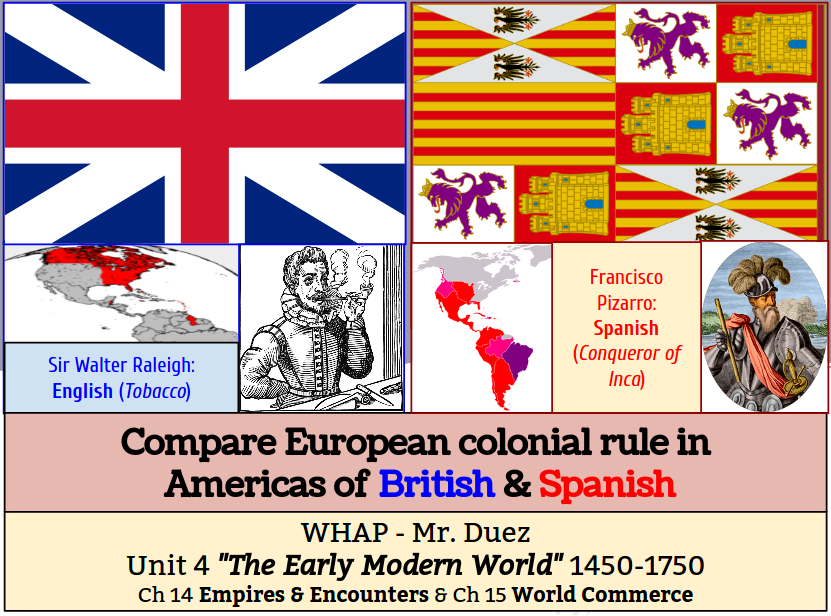
There are some key differences between how the colonial world developed: Slavery, Culture, & Impact on environment.
-----------------------------------------------------------------------------------------------------------
Friday, January  15, 2015
Quote"Strength of character means the ability to overcome resentment against others, to hide hurt feelings, and to forgive quickly." - Lawrence G. Lovasik

Agenda:

1. Andrew Marr's A History of the World: Plunder
We'll watch segments and then discuss as a class.
  • How does it relate to Strayer's Unit 4?
  • What is the big picture?
  • Change Over Time?
  • World Historical Context?
  • Anything Marr's "Point of View" - that may be biased or influenced in some way?
Assignments:
MLK Day - No School Monday
COMP Timed Writing: Wed/Thu Jan 27/28th
Chapter 15 Quiz is on Tuesday, Jan. 19th
Chapter 16 Quiz is on Monday, Jan. 25th
TEST Unit 4 (14, 15, 16): Wed/Thu Jan 27/28th

Agenda: Week of Feb 16 - Feb 20, 2015

Advanced Placement World History with Mr. Duez
Unit 5 - The European Moment, 1750-1914
Ch. 19 & Ch. 20 Colonialism/Imperialism & Shrinking Islamic & Chinese Power
FRQ - Change & Continuity Over Time
Week at a Glance:
MON: No School. President's Day.
TUE: CCOT - Score the 2004 Labor Systems CCOT; Students will read student samples, score them according to the rubric and discuss.
WED/THU: CCOT - Score the 2011 Migrations CCOT; Students will read student samples, score them according to the rubric and discuss.
FRI: Timed Writing CCOT - Flip between the 2004 Labor Systems CCOT & The 2011 Migrations

Write an essay that:
• Has a relevant thesis and supports that thesis with appropriate historical evidence
Addresses all parts of the question
• Uses world historical context to show continuities and changes over time. 
• Analyzes the process of continuity and change over time

1. Analyze changes and continuities in long-distance migrations in the period from 1700 to 1900. Be sure to include specific examples from at least TWO different world regions.

2. Analyze the changes and continuities in labor systems between 1750-1914 in ONE of the following areas. In your analysis, be sure to discuss the causes of the changes and the reasons for the continuities. 
               Latin America and the Caribbean
               Russia                 
               Sub-Saharan Africa
Change over time? No doubt.
---------------------------------------------------------
Monday, Feb 16, 2015
Quote: “If your actions inspire others to dream more, learn more, do more and become more, you are a leader.” -- John Quincy Adams, U.S. president from 1825 to 1829

NO SCHOOL. PRESIDENTS DAY.
Consider the "changes" in a President's appearance over time:
It is one thing to see the difference between the beginning and the end. Can you analyze the forces at work that cause this aging to occur? What must have been occurring during the Presidency of these three gentlemen to cause such changes in appearance?

All three dealt with war during their time in office.

Lincoln led the United States through its Civil War—its bloodiest war and its greatest moral, constitutional and political crisis. In doing so, he preserved the Union, abolished slavery, strengthened the federal government, and modernized the economy.

Eight months into Bush's first term as president, the September 11, 2001 terrorist attacks occurred. In response, Bush launched the War on Terror, an international military campaign which included the war in Afghanistan, launched in 2001 and the war in Iraq, launched in 2003. Bush was both one of the most popular and unpopular presidents in history, having received the highest recorded presidential approval ratings in the wake of the September 11 attacks, as well as one of the lowest approval ratings during the 2008 financial crisis.

Barrack Obama has had plenty to deal with both internally and externally during his two terms in office. Inheriting the 2008 financial crisis was probably his greatest challenge. Many believed the world was heading for a 'great depression' of sorts. In foreign policy, Obama ended U.S. military involvement in the Iraq War, increased U.S. troop levels in Afghanistan, signed the New START arms control treaty with Russia, ordered U.S. military involvement in Libya, and ordered the military operation that resulted in the death of Osama bin Laden. In his second term, Obama ordered U.S. military involvement in Iraq in response to gains made by the Islamic State in Iraq after the 2011 withdrawal from Iraq, continued the process of ending U.S. combat operations in Afghanistan, and has sought to normalize U.S. relations with Cuba.

So all three deal with serious issues at home and abroad during their presidencies. No wonder they aged so quickly during their time in office.
---------------------------------------------------------
Tuesday, Feb 17, 2015
Quote: "Realize that if you have the time to whine and complain about something, then you have the time to do something about it." - Anthony J. D'Angelo

Learning Targets:
Key Concept 5.1 Industrialization and Global Capitalism
I. Industrialization changed fundamentally how goods were produced.
The development of the factory system concentrated labor in a single location and led to an increasing degree of specialization of labor.
VI.The ways in which people organized themselves into societies also underwent significant transformations in industrialized states due to the fundamental restructuring of the global economy.
The new global capitalist economy continued to rely on coerced and semi-coerced labor migration, including slavery, Chinese and Indian indentured servitude and convict labor.
Due to the physical nature of the labor in demand, migrants tended to be male, leaving women to take on new roles in the home society that had been formerly occupied by men.

Discussion Questions:
Analyze the changes and continuities in labor systems between 1750-1914 in ONE of the following areas. In your analysis, be sure to discuss the causes of the changes and the reasons for the continuities. 
               Latin America and the Caribbean
               Russia                 
               Sub-Saharan Africa

Agenda:
1. DO NOW: Pick up the CCOT - 2004 Labor Systems packet from the front. Read through it. 
2. Peer Grade: In groups students will determine the score on a student sample. We will do three of these. Read, grade, discuss, report out the group's score. Then discuss as a full class. Focus on what was done well and what was missed in each sample.
3. Notes, Video, & Discussion: Duez will discuss Labor Systems and how the AP College Board expects students will understand them.
---------------------------------------------------------
Wednesday, Feb 18, 2015 & Thursday, Feb 19, 2015
Quote"Time is like a river. You cannot touch the same water twice, because the flow that has passed will never pass again." - annon

Learning Targets:
I. Migration in many cases was influenced by changes in demography in both industrialized and unindustrialized societies that presented challenges to existing patterns of living. 
  A. Changes in food production and improved medical conditions contributed to a significant global rise in population. 
  B. Because of the nature of the new modes of transportation, both internal and external migrants increasingly relocated to cities. This pattern contributed to the significant global urbanization of the nineteenth century.
II. Migrants relocated for a variety of reasons. 
  A. Many individuals chose freely to relocate, often in search of work. 
Examples of such migrants: 
      • Manual laborers • Specialized professionals
  B. The new global capitalist economy continued to rely on coerced and semi-coerced labor migration. 
Required examples of coerced and semi-coerced labor migration: 
       • Slavery  • Chinese and Indian indentured servitude  • Convict labor 
  C. While many migrants permanently relocated, a significant number of temporary and seasonal migrants returned to their home societies. 
Examples of such temporary and seasonal migrants: 
      • Japanese agricultural workers in the Pacific • Lebanese merchants in the Americas • Italians in Argentina
III. The large-scale nature of migration, especially in the nineteenth century, produced a variety of consequences and reactions to the increasingly diverse societies on the part of migrants and the existing populations. 
  A. Due to the physical nature of the labor in demand, migrants tended to be male, leaving women to take on new roles in the home society that had been formerly occupied by men.  
  B. Migrants often created ethnic enclaves in different parts of the world which helped transplant their culture into new environments and facilitated the development of migrant support networks.  
Examples of migrant ethnic enclaves in different parts of the world: 
      • Chinese in Southeast Asia, the Caribbean, South America, and North America • Indians in East and southern Africa, the Caribbean, and Southeast Asia Picture
  C. Receiving societies did not always embrace immigrants, as seen in the various degrees of ethnic and racial prejudice and the ways states attempted to regulate the increased flow of people across their borders.
Examples of the regulation of immigrants: 
      • The Chinese Exclusion Acts • The White Australia Policy

Discussion Questions:
Analyze changes and continuities in long-distance migrations in the period from 1700 to 1900. Be sure to include specific examples from at least TWO different world regions.

Agenda:
1. DO NOWPick up the CCOT - 2011 Migrations packet from the front. Read through it. 
2. Peer Grade: In groups students will determine the score on a student sample. We will do three of these. Read, grade, discuss, report out the group's score. Then discuss as a full class. Focus on what was done well and what was missed in each sample.
3. Notes, Video, & Discussion: Duez will discuss Long Distance Migrations and how the AP College Board expects students will understand them.
---------------------------------------------------------
Friday, Feb 20, 2015
Quote"Don't let the fear of the time it will take to accomplish something stand in the way of your doing it. The time will pass anyway: we might just as well put that passing time to the best possible use." - Earl Nightengale

Agenda:
1. DO NOW: Prep for the Timed writing. You will need paper and a black pen.
2. FLIP: Mr. Duez will flip a coin heads & tails for the question you will need to write:


1. Analyze changes and continuities in long-distance migrations in the period from 1700 to 1900. Be sure to include specific examples from at least TWO different world regions.

2. Analyze the changes and continuities in labor systems between 1750-1914 in ONE of the following areas. In your analysis, be sure to discuss the causes of the changes and the reasons for the continuities. 
               Latin America and the Caribbean
               Russia                 
               Sub-Saharan Africa

Agenda: Week of Feb. 9 - Feb. 13, 2015


Advanced Placement World History with Mr. Duez
Unit 5: The European Moment, 1750 - 1914
Chapter 17: The Atlantic Revolutions and Their Echoes
-and-
Chapter 18: The Industrial Revolution
Week at a Glance:
MON: Quiz Ch 18; Review 18 Quiz
TUE: Revolutions of Industry; Document Based Question Skills - POV, Historical Context; Analysis
WED/THU: TEST Unit 5, Part I: CH 17 & 18 -- Atlantic Revolutions & Revolutions of Industry
FRI: CCOT Skills; Timelines; WHC; Prep for Timed Writing next Fri.

Test Wed/Thu Unit 5: Part I, CH 17 & 18
No Quiz next week (no school on Monday)

Next Friday, Feb. 20th: CCOT 2 - Timed Writing in class.
Directions: You are to answer the following question. You should spend 5 minutes organizing or outlining your essay.

Write an essay that:
• Has a relevant thesis and supports that thesis with appropriate historical evidence. 
• Addresses all parts of the question. 
• Uses world historical context to show continuities and changes over time. 
• Analyzes the process of continuity and change over time. 

1. Analyze changes and continuities in long-distance migrations in the period from 1700 to 1900. Be sure to include specific examples from at least TWO different world regions.

2. Analyze the changes and continuities in labor systems between 1750-1914 in ONE of the following areas. In your analysis, be sure to discuss the causes of the changes and the reasons for the continuities.
               Latin America and the Caribbean
               Russia                
               Sub-Saharan Africa
Why did the Industrial Revolution take hold and seem to explode in Great Britain?
-------------------------------------------------
Monday, February 9th, 2015
Quote: "Change is the law of life. And those who look only to the past or present are certain to miss the future." - John F. Kennedy

Learning Targets:
• To explore the causes and consequences of the Industrial Revolution
• To root Europe’s Industrial Revolution in a global context
• To examine the question of why industrialization first “took off ” in Great Britain
• To heighten student awareness of both the positive and the negative effects of the Industrial Revolution
• To examine some of the ways in which nineteenth-century industrial powers exerted an economic imperialism over their non-industrialized neighbors

Essential Questions:
1. What was revolutionary about the Industrial Revolution?
2. What was common to the process of industrialization everywhere, and in what ways did that process vary from place to place?
3. What did humankind gain from the Industrial Revolution, and what did it lose?
4. In what ways might the Industrial Revolution be understood as a global rather than simply a European phenomenon?

Agenda:
1. Quiz Chapter 18 The Industrial Revolution
2. Review CH 17 & 18 Quizzes
3. DBQ Analysis. We will do POV, Analysis, and Meaning of several documents regarding Industry and Revolution.
The Russian Revolution definitely qualifies as "Revolution of Industry".
-------------------------------------------------
Tuesday, February 10th, 2015
Quote: "Change does not roll in on the wheels of inevitability, but comes through continuous struggle. And so we must straighten our backs and work for our freedom. A man can't ride you unless your back is bent." - Martin Luther King, Jr.

Learning Targets:
• To explore the causes and consequences of the Industrial Revolution
• To root Europe’s Industrial Revolution in a global context
• To examine the question of why industrialization first “took off ” in Great Britain
• To heighten student awareness of both the positive and the negative effects of the Industrial Revolution
• To examine some of the ways in which nineteenth-century industrial powers exerted an economic imperialism over their non-industrialized neighbors

Essential Questions:
1. What was revolutionary about the Industrial Revolution?
2. What was common to the process of industrialization everywhere, and in what ways did that process vary from place to place?
3. What did humankind gain from the Industrial Revolution, and what did it lose?
4. In what ways might the Industrial Revolution be understood as a global rather than simply a European phenomenon?

Agenda:
1. DO NOW: Review the document on the screen, write out the meaning & point of view.
2. Notes, Video, Discussion: Revolutions of Industry
3. DBQ Analysis. We will do POV, Analysis, and Meaning of several documents regarding Industry and Revolution. 
Link to DBQ for Industrial Revolution 
Link to DBQ for Atlantic Revolutions
-------------------------------------------------
Wednesday, February 11th and 12th, 2015
Quote: "To improve is to change; to be perfect is to change often." - Winston Churchill

Agenda:
1. TEST - Unit 5 - The European Moment, Part I:
Chapter 17 Atlantic Revolutions & Chapter 18 Revolutions of Industry
The Industrial Revolution made life better, but progress came with a cost. 
-------------------------------------------------
Friday, February 13, 2015
Quote: "I have noticed even people who claim everything is predestined, and that we can do nothing to change it, look before they cross the road." - Stephen Hawking

Agenda:
1. DO NOW: Pick up the CCOT Packet from the front of the room. 
2. CCOT: Timeline, tips, and practice.
Thesis writing
Analysis
Showing change/continuity over time
World Historical Context
Ok, get ready... set... let's go! CCOT #2 of the spring.
--------------------------------------------------------------------------
Next Friday, Feb. 20th: CCOT 2 - Timed Writing in class.
Directions: You are to answer the following question. You should spend 5 minutes organizing or outlining your essay.

Write an essay that:
• Has a relevant thesis and supports that thesis with appropriate historical evidence. 
• Addresses all parts of the question. 
• Uses world historical context to show continuities and changes over time. 
• Analyzes the process of continuity and change over time. 

1. Analyze changes and continuities in long-distance migrations in the period from 1700 to 1900. Be sure to include specific examples from at least TWO different world regions.

2. Analyze the changes and continuities in labor systems between 1750-1914 in ONE of the following areas. In your analysis, be sure to discuss the causes of the changes and the reasons for the continuities.
               Latin America and the Caribbean
               Russia                
               Sub-Saharan Africa

Agenda: Week of March 24 - March 28, 2014

Advanced Placement World History with Mr. Duez
Unit 6: The Most Recent Century, 1914 - 2010
Chapter 21: Collapse & Recovery of Europe
World War II
Week at a Glance:
MON - WWII: War in Europe - Stalingrad, D-Day, Battle of the Bulge; War in the Pacific
TUE -  Article on Pearl Harbor due in class at beginning; Discuss Pearl Harbor article; Pearl Harbor,
WED/THU - TEST CH 21, Part II WWII & Recovery; CCOT Prep
FRI - CCOT Prep & Introduction to CH 22 - Communism: Rise & Fall
The 101st Airborne Division: The Screaming Eagles gained widespread recognition by virtue of HBO's Band of Brothers.
-------------------------------------
Learning Targets:
 •  To examine the history of Europe between 1914 and the 1970s as an organic whole made up of closely interconnected parts
 •  To consider the repercussions of nationalism and colonialism in Europe and Japan
 •  To increase student awareness of the effects of the two world wars
 •  To help students imagine the appeal of totalitarian movements in the twentieth century 

Essential Questions:
BIG PICTURE QUESTIONS
      1.   What explains the disasters that befell Europe in the first half of the twentieth century?
      2.   In what ways were the world wars a motor for change in the history of the twentieth century?
      3.   To what extent were the two world wars distinct and different conflicts, and in what ways were they related to each other? In particular, how did the First World War and its aftermath lay the foundations for World War II?
      4.   In what ways did Europe’s internal conflicts between 1914 and 1945 have global implications?

Margin Review Questions
      1.   What aspects of Europe’s nineteenth-century history contributed to the First World War?
      2.   In what ways did World War I mark new departures in the history of the twentieth century?
      3.   In what ways was the Great Depression a global phenomenon?
      4.   In what ways did fascism challenge the ideas and practices of European liberalism and democracy?
      5.   What was distinctive about the German expression of fascism? What was the basis of popular support for the Nazis?
      6.   How did Japan’s experience during the 1920s and 1930s resemble that of Germany, and how did it differ?
      7.   In what way were the origins of World War II in Asia and in Europe similar to each other? How were they different?
      8.   How did World War II differ from World War I?
      9.   How was Europe able to recover from the devastation of war?
HBO's The Pacific: The very best miniseries about WWII in the Pacific theater ever made.
-------------------------------------
Monday, March 24, 2014
Quote"Fold the worst events in your life into a narrative of triumph." - Andrew Solomon

Agenda:
1. DO NOW QUESTION: What were the two major strategic mistakes that Hitler had in World War II? Explain how the Axis lose WWII.
2. Notes, Video, Discussion: Stalingrad, D-Day, Battle of the Bulge, V-E Day: The End of the War in Europe.
3. If time, discuss Pearl Harbor.
The destruction of Hiroshima is remembered today by the ruins that make up the Hiroshima Peace Museum. 
-------------------------------------
Tuesday, March 25, 2014
Quote: "Everything you do is triggered by an emotion of either desire or fear." - Brian Tracy

Agenda:
1. DO NOW QUESTION: (Prep to turn in the article on Pearl Harbor) Do you believe the United States should have dropped the A-Bombs on Japan to end World War I? Why or why not? What was the strategic thinking behind Truman's decision?
2. Notes, Video, Discussion: Pearl Harbor, The Pacific Theater of War, End of War - VJ-Day
3. Notes, Video, Discussion: Post War Recovery & Rebuild. The Cold War Begins.
A "shadow" of a hand wheel on a painted wall of a gas tank. Radiant heat waves from the Hiroshima bombing burned paint anywhere that its rays were not obstructed. 
-------------------------------------
Wednesday, March 26 and Thursday, March 27, 2014
Quote: "Do not look where you fell but where you slipped." - Proverb

Agenda:
1. TEST CH 21, Part II: WWII & Recovery
2. CCOT Questions - Pick up and review. How much do you know about the questions right now? Map out possible thesis, evidence, and plan.
CCOT Questions for Friday, April 4, 2014:I. Analyze continuities and changes in nationalist ideology and practice in ONE of the following regions from the First World War to the present:   • Middle East • Southeast Asia • Sub-Saharan Africa
II. Analyze changes and continuities in long-distance migrations in the period from 1700 to 1900. Be sure to include specific examples from at least TWO different world regions.
3. Discuss CH 22: Rise & Fall of Communism
The horrors of war struck innocent civilians during World War II, like nothing before it in history. 
-------------------------------------
Friday, March 28, 2014
Quote: "Some people skate to the puck. I skate to where the puck is going to be." - Wayne Gretzky

Agenda:
1. DO NOW QUESTION: What is national ideology & practice? Name 2 long-distant migrations in history from 1700 - 1900.
2. CCOT Preparation: We will work in groups to break down the CCOT prompts and prepare for the timed writing for next Friday.
3. Introduction to CH 22: Rise & Fall of Communism
Comparing Russian Revolution to French Revolution

Timed Writing CCOT next Friday

CCOT Options for Timed Writing on Friday, Nov. 22nd

We will begin prepping for the CCOT Monday after the quiz, Tuesday, & Block day next week. On Friday Nov. 22nd, Mr. Duez will flip a coin and we'll decide on one of the two questions below for each class. You will not be able to use any notes on the timed writing. However you have all week to prepare your answers for these questions. This is a test grade. And it is a wonderful opportunity to improve your grade.

Good luck! Literally.
2 Questions, 2 Faces, 2 Sides to the Coin.
The question will focus on:

1. Analyze continuities and changes that resulted from the spread of Islam into ONE of the following regions in the period between circa 800 C.E. and circa 1750:   
      • West Africa • South Asia • Europe

2. Analyze continuities and changes in trade networks between Africa and Eurasia from circa 300 C.E. to 1450 C.E
   
Information to help you prepare:
  CCOT Fact Sheet
  How to write the CCOT
  Notes - CCOT Essay

Agenda: Week of April 8 - April 12, 2013

Advanced Placement World History with Mr. Duez
Unit 6: The Most Recent Century
CHAPTER 22: World of Communism, 1917 - 1999
CHAPTER 23 Independence and Development in the Global South 1914–Present
Week at a Glance:
MON: Quiz 22; CCOT prep
TUE: USSR & PRC Comparison; CCOT Prep
WED/THU: CCOT; Begin Ch. 23/24
FRI: African Independence & Democracy
=====================================
Targets - Chapter 22 - "World Communism: Rise and Fall"
•  To examine the nature of the Russian and Chinese revolutions and how the differences between those revolutions affected the introduction of communist regimes in those countries
 •  To consider how communist states developed, especially in the USSR and the People’s Republic of China
 •  To consider the benefits of a communist state
 •  To consider the harm caused by the two great communist states of the twentieth century
 •  To introduce students to the cold war and its major issues
 •  To explore the reasons why communism collapsed in the USSR and China
 •  To consider how we might assess the communist experience . . . and to inquire if historians should be asking such questions about moral judgment
Essential Questions - Chapter 22 - "World Communism: Rise and Fall"
* Analyze the impact of Communism in Russia from 1917-1991 in light of the changes and continuities that took place in THREE of the following: Government, Civil rights, Philosophy and religion, Economics
* Analyze the impact of Communism in China from 1949 - present in light of the changes and continuities that took place in THREE of the following: Government, Civil rights, Philosophy and religion, Economics 
=====================================
Monday, April 8, 2013
Quote: “A man may die, nations may rise and fall, but an idea lives on. Ideas have endurance without death.” - John F. Kennedy, December 14, 1962.

Agenda:
1. Quiz - Chapter 22
2. Pick up the CCOT How-To Packet
3. Notes, Video, Discussion: Discuss Russian-American relations during the Cold War.
=====================================
Tuesday, April 9, 2013
Quote: “The survivors (of a nuclear war) would envy the dead.” - Nikita Khrushchev, July 20, 1963

Agenda:
1. Do Now Question: Analyze the impact of Communism in China or Russsia in light of the changes and continuities that took place in THREE of the following: Government, Civil rights, Philosophy and religion, Economics 
2. Notes, Discussion, Video: How to format the CCOT specifically for our Chapter 22 question. Preparation is key. You need to know both Russia and China. We'll determine the question by a flip of a coin each period. Heads = Mao (His head was so big, his 4head was actually and 8head. Tails=Russia (we kicked their tails in the Cold War).
=====================================
Targets Chapter 23 Independence and Development in the Global South
LEARNING TARGETS:
To explore the breakup of imperial systems in the twentieth century
To consider, through the examples of India and South Africa, how the process of decolonization worked
To examine the challenges that faced developing nations in the second half of the twentieth century
To investigate the potential clash of tradition with modernity in the developing nations, especially considering the case of Islam in Turkey and Iran
ESSENTIAL QUESTIONS:
       1.   In what ways did the colonial experience and the struggle for independence shape the agenda of developing countries in the second half of the twentieth century?
      2.   To what extent did the experience of the former colonies and developing countries in the twentieth century parallel that of the earlier “new nations” in the Americas in the eighteenth and nineteenth centuries?
      3.   How would you compare the historical experience of India and China in the twentieth century?
      4.   From the viewpoint of the early twenty-first century, to what extent had the goals of nationalist or independence movements been achieved?
=====================================
Wednesday, April 10, 2013 & Thursday, April 11, 2013
Quote: “I am not what happened to me, I am what I choose to become.” - Carl Jung
Agenda:
1. CCOT Chapter 22 - First 35 minutes.
2. Do Now QuestionWhat obstacles confronted the leaders of movements for independence?
3. Notes, Video, & Discussion: Chapter 23 - Independence & Development in the Global South
=====================================
Friday, April 11, 2013
Quote"For to be free is not merely to cast off one's chains, but to live in a way that respects and enhances the freedom of others." - Nelson Mandela
Agenda:
1. Do Now Question
2. Notes, Video, Discussion: South African Independence
Capetown, South Africa