Showing posts with label Chapter 23 Independence and Development in the Global South. Show all posts

Agenda: Week of April 6-10, 2015

Advanced Placement World History with Mr. Duez
Unit 6 - The Most Recent Century
QUICK AGENDA:
MON: Quiz CH 23, Review CH 23 QUIZ; if time Crash Course
TUE: Get CCOT Essays Back; Discuss the struggle for independence in light of what the focus of the new independent states valued.
WED/THU: Indian Independence; South African Apartheid; Document Study
FRI: Pick up Questions to consider for Chapter 24. The Global Economy, Feminism
Global Modernity & Religious Fundamentalism, Environmentalism

QUIZ CH 24 on Monday, April 13th
TEST CH 23 & 24 on Wed/Thu April 15 & 16
=====================================
Chapter 23 - Independence in the Global South - TARGETS
LEARNING TARGETS:
* To explore the breakup of imperial systems in the twentieth century
* To consider, through the examples of India and South Africa, how the process of decolonization worked
* To examine the challenges that faced developing nations in the second half of the twentieth century
* To investigate the potential clash of tradition with modernity in the developing nations, especially considering the case of Islam in Turkey and Iran

ESSENTIAL QUESTIONS:
1.   In what ways did the colonial experience and the struggle for independence shape the agenda of developing countries in the second half of the twentieth century?
2.   To what extent did the experience of the former colonies and developing countries in the twentieth century parallel that of the earlier “new nations” in the Americas in the eighteenth and nineteenth centuries?
3.   How would you compare the historical experience of India and China in the twentieth century?
4.   From the viewpoint of the early twenty-first century, to what extent had the goals of nationalist or independence movements been achieved?
=====================================
Monday, April 7, 2014
Quote: “I am not what happened to me, I am what I choose to become.” - Carl Jung

Agenda:
1. DO NOW: Prep for quiz Chapter 23: Reading Check
2. QUIZ: Reading Check CH. 23
After the quiz: What obstacles confronted the leaders of movements for independence?
3. Review Quiz
4. (if time) Video & DiscussionCrash Course WH: Decolonization & Nationalism
--------------------------------------------------------
Tuesday, April 8, 2014
Quote: "What a distressing contrast there is between the radiant intelligence of the child and the feeble mentality of the average adult." - Sigmund Freud

Agenda:
1. DO NOW QUESTION"In what ways did the colonial experience and the struggle for independence shape the agenda of developing countries in the second half of the twentieth century?"
2. Pass back CCOT: Discuss common errors and mistakes. (10 min)
3. Notes, Video, & Discussion:
Discuss
Who was Gandhi? (Indian Independence Notes)
Why was Africa’s experience with political democracy so different from that of India?
Who is Nelson Mandela? (African Independence Notes)
DiscussWhat accounts for the ups and downs of political democracy in post-colonial Africa?

Assignments: 
Quiz CH 24 next Monday
TEST 23-24 Plus Comparative Timed Writing next Wed/Thu
--------------------------------------------------------
Wednesday, April 9, 2014 -and- Thursday, April 10, 2014
Quote"An eye for an eye only ends up making the whole world blind." - Mahatma Gandhi

Agenda:
1. DO NOW: Pick up handout - Document Study & Visual Sources CH 23. Read silently for 15 minutes.
2. Notes, Video, Discussion: Why was Africa’s experience with political democracy so different from that of India?
What accounts for the ups and downs of political democracy in post-colonial Africa?

Document Study in groups: Answer questions, jigsaw the documents. Present findings.
"In what ways did the colonial experience and the struggle for independence shape the agenda of developing countries in the second half of the twentieth century?"
--------------------------------------------------------
Chapter 24 - Accelerating Global Interactions Since 1945 - TARGETS
LEARNING TARGETS:
• To consider the steps since 1945 that have increasingly made human populations into a single “world” rather than citizens of distinct nation-states
• To explore the factors that make it possible to speak now of a true “world economy”
• To explore the debate about economic globalization
• To raise student awareness of global liberation movements, especially feminism, and their implications for human life
• To investigate the “fundamentalist” religious response to aspects of modernity
• To consider environmentalism as a matter that cannot help but be global because the stakes are so high for all humankind
• To step back and ponder the value of studying history

QUESTIONS TO CONSIDER:
1. What factors contributed to economic globalization during the twentieth century?
2. In what ways has economic globalization linked the world’s peoples more closely together?
3. What new or sharper divisions has economic globalization generated?
4. What distinguished feminism in the industrialized countries from that of the Global South?
5. In what respect did the various religious fundamentalists of the twentieth century express hostility to global modernity?
6. From what sources did Islamic renewal movements derive?
7. In what different ways did Islamic renewal express itself?
8. How can we explain the dramatic increase in the human impact on the environment in the twentieth century?
9. What differences emerged between environmentalism in the Global North and that in the Global South?
--------------------------------------------------------
Friday, April 9, 2014
Quote: "I learned that courage was not the absence of fear, but the triumph over it. The brave man is not he who does not feel afraid, but he who conquers that fear." - Nelson Mandela

1. DO NOW: Pick up Questions to consider for Chapter 24.
2. Notes, Video, Discussion: Chapter 24 Main Themes:
The Global Economy
Feminism
Global Modernity & Religious Fundamentalism
Environmentalism

Quiz on Chapter 24 - Monday. LAST STRAYER QUIZ!!!!
Test next Wed/Thu.

Agenda: Week of April 7 - April 11, 2014

Advanced Placement World History with Mr. Duez
Unit 6 - The Most Recent Century
Chapter 23 Independence and Development in the Global South
QUICK AGENDA:
MON: Quiz CH 23, Crash Course Decolonization & Nationalism
TUE: Review CH 22, Cold War & Comparing Chinese & Russian Communism
WED/THU: Indian Independence; South African Apartheid
FRI: Document Study
=====================================
Targets Chapter 23 Independence and Development in the Global South

LEARNING TARGETS:
* To explore the breakup of imperial systems in the twentieth century
* To consider, through the examples of India and South Africa, how the process of decolonization worked
* To examine the challenges that faced developing nations in the second half of the twentieth century
* To investigate the potential clash of tradition with modernity in the developing nations, especially considering the case of Islam in Turkey and Iran

ESSENTIAL QUESTIONS:
1.   In what ways did the colonial experience and the struggle for independence shape the agenda of developing countries in the second half of the twentieth century?
2.   To what extent did the experience of the former colonies and developing countries in the twentieth century parallel that of the earlier “new nations” in the Americas in the eighteenth and nineteenth centuries?
3.   How would you compare the historical experience of India and China in the twentieth century?
4.   From the viewpoint of the early twenty-first century, to what extent had the goals of nationalist or independence movements been achieved?
=====================================
Monday, April 7, 2014
Quote: “I am not what happened to me, I am what I choose to become.” - Carl Jung

Agenda:
1. DO NOW: Prep for quiz Chapter 23 - Reading Check.
2. QUIZ: Reading Check CH. 23.
After the quiz: What obstacles confronted the leaders of movements for independence?
3. Video & DiscussionCrash Course WH: Decolonization & Nationalism
--------------------------------------------------------
Tuesday, April 8, 2014
Quote: "What a distressing contrast there is between the radiant intelligence of the child and the feeble mentality of the average adult." - Sigmund Freud

Agenda:
1. DO NOW QUESTION: How does the Cold War lead to a proxy "Third World" War?
2. Notes, Video, Discussion: Comparing Russian & Chinese Communism (quick 10 min. wrap)
3. Notes, Video, Discussion: The Cold War (quick 10 min. wrap)
4. Video: Ferguson's China Triumph & Turmoil. Part I of III.
Ferguson looks at the biggest and fastest industrial revolution in history, compressed into just 40 years.
From the madness of Mao, to the newly minted billionaires, to the Mao-worshipers who believe tomorrow belongs to them. What would it be like to live in a Chinese dominated world? Or will the Red Dragon crash and burn, as it has in the past... through turmoil.
--------------------------------------------------------
Wednesday, April 9, 2014 -and- Thursday, April 10, 2014
Quote"An eye for an eye only ends up making the whole world blind." - Mahatma Gandhi

Agenda:
1. DO NOW"In what ways did the colonial experience and the struggle for independence shape the agenda of developing countries in the second half of the twentieth century?"
2. Notes, Video, Discussion:  Who was Gandhi? (Indian Independence Notes)
Trailer for the Movie Gandhi 5:09
Gandhi is a 1982 biographical film based on the life of Mahatma Gandhi, who led the nonviolent resistance movement against British colonial rule in India during the first half of the 20th century. The film was directed by Richard Attenborough and stars Ben Kingsley as Gandhi."

Video Clip 9:21: "In Search of Gandhi"
Gandhi, Mohandas K.: Usually referred to by “Mahatma” (Great Soul), Gandhi (1869–1948) was a political leader and the undoubted spiritual leader of the Indian drive for independence from Great Britain. (pron. moh-HAHN-dahs GAHN-dee)

3. Discuss: Why was Africa’s experience with political democracy so different from that of India?

Who is Nelson Mandela? (African Independence Notes)
Video Clip 8:23: "ESPY Awards 2009 Award for Courage: A short documentary for the ESPN Espy awards. This year the Arthur Ashe Award for Courage was presented to Nelson Mandela, and his work to unite his country through love of sport."

Mandela, Nelson: South African nationalist (b. 1918) and leader of the African National Congress who was imprisoned for twenty-seven years on charges of treason, sabotage, and conspiracy to overthrow the apartheid government of South Africa; he was elected president of South Africa in 1994, four years after he was finally released from prison. (pron. man-DEL-ah)

4. Discuss: What accounts for the ups and downs of political democracy in post-colonial Africa?
--------------------------------------------------------
Friday, April 9, 2014
Quote: "I learned that courage was not the absence of fear, but the triumph over it. The brave man is not he who does not feel afraid, but he who conquers that fear." - Nelson Mandela

1. DO NOW: Pick up handout - Document Study & Visual Sources CH 23. Read silently for 15 minutes.
2. Document Study in groups: Answer questions, jigsaw the documents. Present findings.

Quiz on Chapter 24 - Monday.
Test next Wed/Thu.

Chapter 23 - Document Study & Visual Sources

YouTube - Chapter 23 - Document Study & Visual Sources
Notes - Chapter 23 - Document Study & Visual Sources
Visual Source 23.3 -- Vietnamese Independence and Victory over the United States.


Chapter 23 - Ups and Downs of African Independence Movements

YouTube - Chapter 23 - Ups and Downs of African Independence Movements
Notes - Chapter 23 - Ups and Downs of African Independence Movements
Mozambique & Independence: mural depiction


Notes - Comparing African and Indian Movements

YouTube - Comparing African and Indian Movements
Notes - Comparing African and Indian Movements

Notes - Chapter 23 - Developing Countries

YouTube - Chapter 23 - Developing Countries
Notes - Chapter 23 - Developing Countries

Notes: Chapter 23 - Imperial Disintegration

YouTube: Chapter 23 - Imperial Disintegration
Notes: Chapter 23 - Imperial Disintegration

Notes - Chapter 23 - Nelson Mandela & South African Apartheid

YouTube - Chapter 23 - Nelson Mandela & South African Apartheid
Notes - Chapter 23 - Nelson Mandela & South African Apartheid

Targets - CH 23 - Independence in the Global South

Targets: Chapter 23 - Independence in the Global South

Agenda: April 15 - April 19, 2013

Advanced Placement World History with Mr. Duez
Unit 6 - The Most Recent Century
Chapter 23 - Independence and Development in the Global South, 1914-present
Chapter 24 - Accelerating Global Interactions
WEEK AT A GLANCE:
MON
- Quiz Ch 23 & 24; Crash Course - Decolonization & Nationalism Triumph

TUE - Notes - Gandhi & Indian Independence
WED/THU - Notes - Nelson Mandela - South African Apartheid Ends & Document Study for Chapter 23 and 24.
FRI - LAST STRAYER TEST - Chapters 23 & 24
==========================================
Learning Targets CHAPTER 23 "Independence and Development in the Global South 1914–Present"
• To explore the breakup of imperial systems in the twentieth century
• To consider, through the examples of India and South Africa, how the process of decolonization worked
• To examine the challenges that faced developing nations in the second half of the twentieth century
• To investigate the potential clash of tradition with modernity in the developing nations, especially considering the case of Islam in Turkey and Iran

Learning Targets CHAPTER 24 "Accelerating Global Interaction"
• To consider the steps since 1945 that have increasingly made human populations into a
single “world” rather than citizens of distinct nation-states
• To explore the factors that make it possible to speak now of a true “world economy”
• To explore the debate about economic globalization
• To raise student awareness of global liberation movements, especially feminism, and
their implications for human life
• To investigate the “fundamentalist” religious response to aspects of modernity
• To consider environmentalism as a matter that cannot help but be global because the
stakes are so high for all humankind
• To step back and ponder the value of studying history
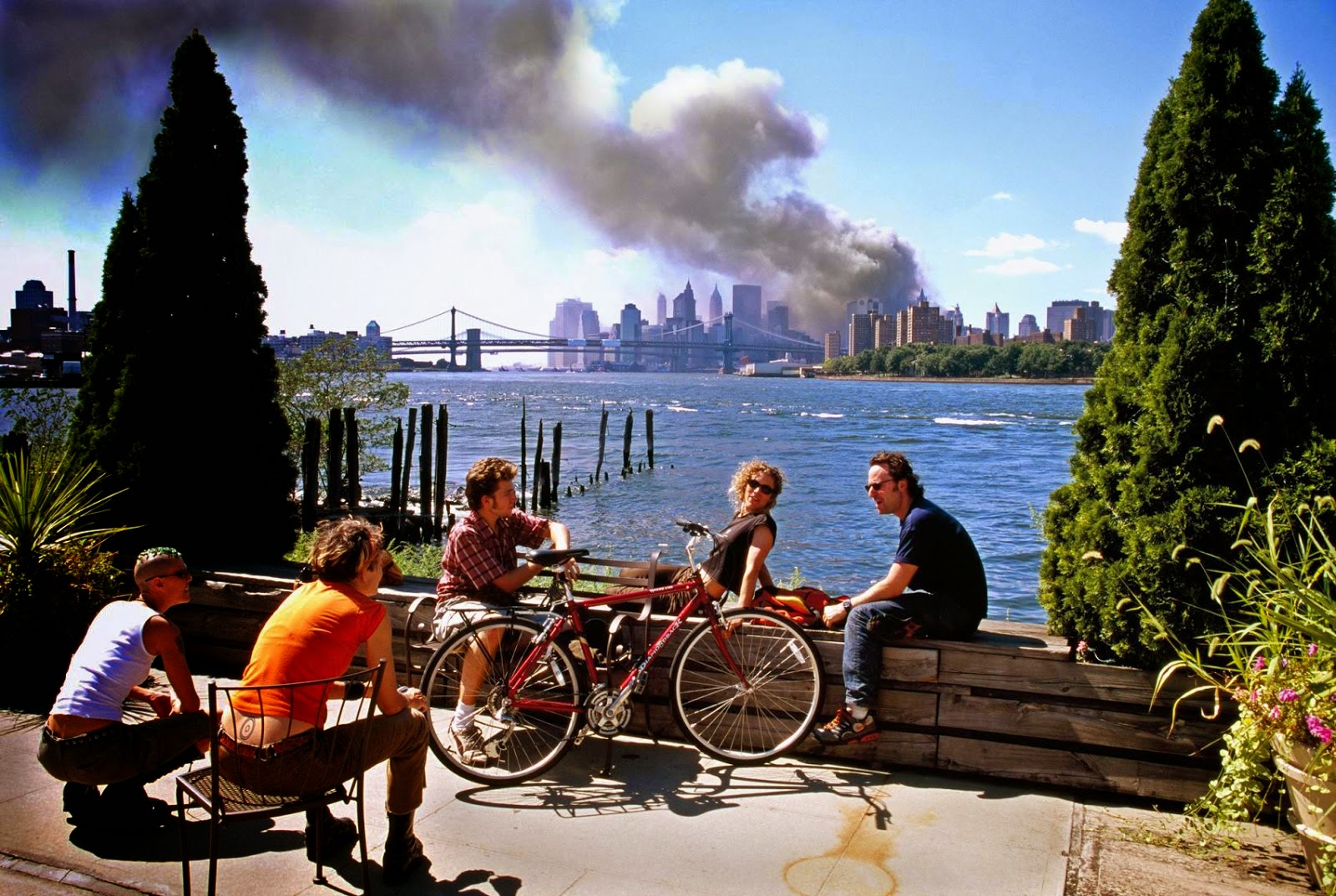
Controversial 911 picture: Are people in the image aware of what was happening behind? Or they just did not care!
==========================================
Monday, April 15, 2013
Quote: "An eye for an eye only ends up making the whole world blind." - Mahatma Gandhi

Agenda:
1. DO NOW - Prep for quiz. After the quiz: "What was distinctive about the end of Europe’s African and Asian empires compared to other cases of imperial disintegration?"
2. Video & Discussion: Crash Course World History: #40 - Decolonization & Nationalism Triumph
==========================================

Tuesday, April 16, 2013
Quote: "For to be free is not merely to cast off one's chains, but to live in a way that respects and enhances the freedom of others." - Nelson Mandela

Agenda:
1. DO NOW QUESTION: Big Picture Question 1 - "In what ways did the colonial experience and the struggle for independence shape the agenda of developing countries in the second half of the twentieth century?"
2. Notes, Discussion, & Video: 
Who was Gandhi? (Indian Independence Notes)
Trailer for the Movie Gandhi 5:09 Gandhi is a 1982 biographical film based on the life of Mahatma Gandhi, who led the nonviolent resistance movement against British colonial rule in India during the first half of the 20th century. The film was directed by Richard Attenborough and stars Ben Kingsley as Gandhi."
Video Clip 9:21: "In Search of Gandhi"
Gandhi, Mohandas K.: Usually referred to by his soubriquet “Mahatma” (Great Soul), Gandhi (1869–1948) was a political leader and the undoubted spiritual leader of the Indian drive for independence from Great Britain. (pron. moh-HAHN-dahs GAHN-dee)
Who is Nelson Mandela? (African Independence Notes)
Video Clip 8:23: "ESPY Awards 2009 Award for Courage: A short documentary for the ESPN Espy awards. This year the Arthur Ashe Award for Courage was presented to Nelson Mandela, and his work to unite his country through love of sport."
Mandela, Nelson: South African nationalist (b. 1918) and leader of the African National Congress who was imprisoned for twenty-seven years on charges of treason, sabotage, and conspiracy to overthrow the apartheid government of South Africa; he was elected president of South Africa in 1994, four years after he was finally released from prison. (pron. man-DEL-ah)
What accounts for the ups and downs of political democracy in post-colonial Africa?

==========================================
Wednesday, April 17, 2013 & Thursday, April 18, 2013
I can't believe I read the whole thing!
Quote: "I learned that courage was not the absence of fear, but the triumph over it. The brave man is not he who does not feel afraid, but he who conquers that fear." - Nelson Mandela

Agenda:
2. Document Study: Class handout to assist in answering the document questions. We will hand this in at the end of the class period.
I. Document Study: Document 23.2: Development and African Unity
II. Visual Source Study: Visual Source 23.1: “Non-Co-operation Tree and Mahatma Gandhi” (pictured above)
3. Review Questions: In class group discussion to answer review questions over Chapter 24. Review Questions
4. Notes, Video, Discussion:  Chapter 24 Presentation
==========================================
Friday, April 19, 2013
Quote: "A 'No' uttered from the deepest conviction is better than a 'Yes' merely uttered to please, or worse, to avoid trouble." - Mahatma Gandhi

1. LAST STRAYER TEST OF THE YEAR! WOW. Chapter 23 and 24. Monday - we start review!

Agenda: Week of April 8 - April 12, 2013

Advanced Placement World History with Mr. Duez
Unit 6: The Most Recent Century
CHAPTER 22: World of Communism, 1917 - 1999
CHAPTER 23 Independence and Development in the Global South 1914–Present
Week at a Glance:
MON: Quiz 22; CCOT prep
TUE: USSR & PRC Comparison; CCOT Prep
WED/THU: CCOT; Begin Ch. 23/24
FRI: African Independence & Democracy
=====================================
Targets - Chapter 22 - "World Communism: Rise and Fall"
•  To examine the nature of the Russian and Chinese revolutions and how the differences between those revolutions affected the introduction of communist regimes in those countries
 •  To consider how communist states developed, especially in the USSR and the People’s Republic of China
 •  To consider the benefits of a communist state
 •  To consider the harm caused by the two great communist states of the twentieth century
 •  To introduce students to the cold war and its major issues
 •  To explore the reasons why communism collapsed in the USSR and China
 •  To consider how we might assess the communist experience . . . and to inquire if historians should be asking such questions about moral judgment
Essential Questions - Chapter 22 - "World Communism: Rise and Fall"
* Analyze the impact of Communism in Russia from 1917-1991 in light of the changes and continuities that took place in THREE of the following: Government, Civil rights, Philosophy and religion, Economics
* Analyze the impact of Communism in China from 1949 - present in light of the changes and continuities that took place in THREE of the following: Government, Civil rights, Philosophy and religion, Economics 
=====================================
Monday, April 8, 2013
Quote: “A man may die, nations may rise and fall, but an idea lives on. Ideas have endurance without death.” - John F. Kennedy, December 14, 1962.

Agenda:
1. Quiz - Chapter 22
2. Pick up the CCOT How-To Packet
3. Notes, Video, Discussion: Discuss Russian-American relations during the Cold War.
=====================================
Tuesday, April 9, 2013
Quote: “The survivors (of a nuclear war) would envy the dead.” - Nikita Khrushchev, July 20, 1963

Agenda:
1. Do Now Question: Analyze the impact of Communism in China or Russsia in light of the changes and continuities that took place in THREE of the following: Government, Civil rights, Philosophy and religion, Economics 
2. Notes, Discussion, Video: How to format the CCOT specifically for our Chapter 22 question. Preparation is key. You need to know both Russia and China. We'll determine the question by a flip of a coin each period. Heads = Mao (His head was so big, his 4head was actually and 8head. Tails=Russia (we kicked their tails in the Cold War).
=====================================
Targets Chapter 23 Independence and Development in the Global South
LEARNING TARGETS:
To explore the breakup of imperial systems in the twentieth century
To consider, through the examples of India and South Africa, how the process of decolonization worked
To examine the challenges that faced developing nations in the second half of the twentieth century
To investigate the potential clash of tradition with modernity in the developing nations, especially considering the case of Islam in Turkey and Iran
ESSENTIAL QUESTIONS:
       1.   In what ways did the colonial experience and the struggle for independence shape the agenda of developing countries in the second half of the twentieth century?
      2.   To what extent did the experience of the former colonies and developing countries in the twentieth century parallel that of the earlier “new nations” in the Americas in the eighteenth and nineteenth centuries?
      3.   How would you compare the historical experience of India and China in the twentieth century?
      4.   From the viewpoint of the early twenty-first century, to what extent had the goals of nationalist or independence movements been achieved?
=====================================
Wednesday, April 10, 2013 & Thursday, April 11, 2013
Quote: “I am not what happened to me, I am what I choose to become.” - Carl Jung
Agenda:
1. CCOT Chapter 22 - First 35 minutes.
2. Do Now QuestionWhat obstacles confronted the leaders of movements for independence?
3. Notes, Video, & Discussion: Chapter 23 - Independence & Development in the Global South
=====================================
Friday, April 11, 2013
Quote"For to be free is not merely to cast off one's chains, but to live in a way that respects and enhances the freedom of others." - Nelson Mandela
Agenda:
1. Do Now Question
2. Notes, Video, Discussion: South African Independence
Capetown, South Africa